
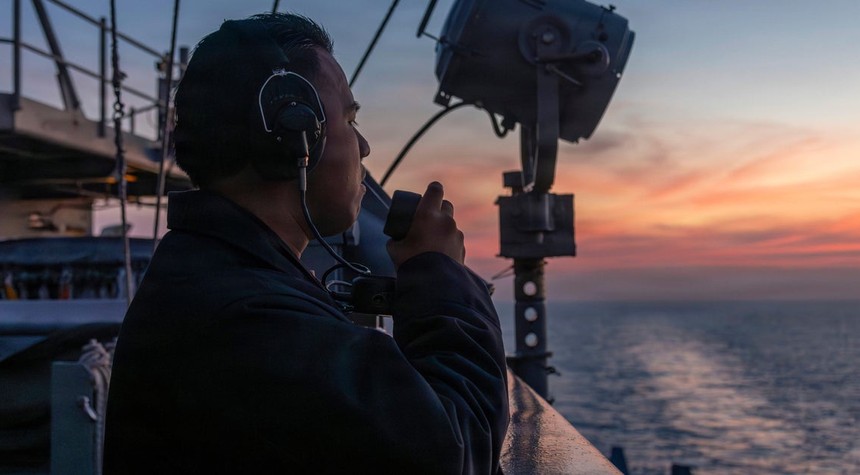
The USS Abraham Lincoln aircraft carrier strike group has entered the waters of Central Command, the operational theater encompassing the Middle East and Iran, according to U.S. military officials. This deployment represents a significant escalation in American naval presence as tensions between Washington and Tehran reach their highest point in years.
The strike group consists of the aircraft carrier Abraham Lincoln accompanied by three Arleigh Burke-class guided missile destroyers: the USS Frank E. Petersen, Jr., the USS Spruance, and the USS Michael Murphy. The Lincoln’s air wing includes squadrons of F/A-18E/F Super Hornets, EA-18G Growler electronic warfare aircraft, F-35C Lightning II fighter jets, and MH-60R/S Seahawk helicopters. This represents a formidable projection of American military power into a region where Iranian influence has grown substantially over the past decade.
As of Monday morning, the naval force had not yet reached its final operational position, though it had crossed into the Central Command area of responsibility. The movement comes in direct response to escalating threats from Iranian military leadership and follows President Trump’s announcement last Thursday that a “massive fleet” was heading toward Iran “just in case” action becomes necessary, though he expressed hope that military force would not be required.
The timing of this deployment coincides with Iran’s largest domestic upheaval in years. Mass demonstrations that began in late December have challenged the Islamic Republic’s ruling regime in unprecedented ways. President Trump has issued repeated warnings to Iranian leaders against the killing of peaceful demonstrators and the mass execution of those arrested during the protests. These warnings appear to have struck a nerve in Tehran.
Iranian military officials have responded with increasingly bellicose rhetoric. General Mohammad Pakpour of the Islamic Revolutionary Guard Corps warned the United States and Israel “to avoid any miscalculation,” stating that the Revolutionary Guards stand “more ready than ever, finger on the trigger, to execute the orders and directives of the Commander-in-Chief.” This statement, reported through Nournews, an outlet with close ties to Iran’s Supreme National Security Council, represents the kind of inflammatory language that has characterized Iranian military posturing for decades.
On Monday, the warnings intensified. General Reza Talaei-Nik, spokesperson for Iran’s Defense Ministry, declared that any potential attack by Israel or the United States would “be met with a response that is more painful and more decisive than in the past.”
The current situation presents a familiar pattern in Middle Eastern geopolitics: American military power deployed as both deterrent and potential instrument of policy, facing an Iranian regime that has historically used threatening rhetoric to rally domestic support while testing American resolve. What remains different this time is the internal pressure facing Tehran’s leadership from its own population, a factor that could make the regime either more cautious or more reckless in its calculations.
The Abraham Lincoln strike group’s presence in these waters serves multiple purposes: protecting American interests, reassuring regional allies, and providing the President with military options should diplomacy fail. Whether this deployment prevents conflict or presages it remains the crucial question facing both capitals.
Related: American Climber Alex Honnold Scales Taiwan’s Taipei 101 Without Safety Equipment