
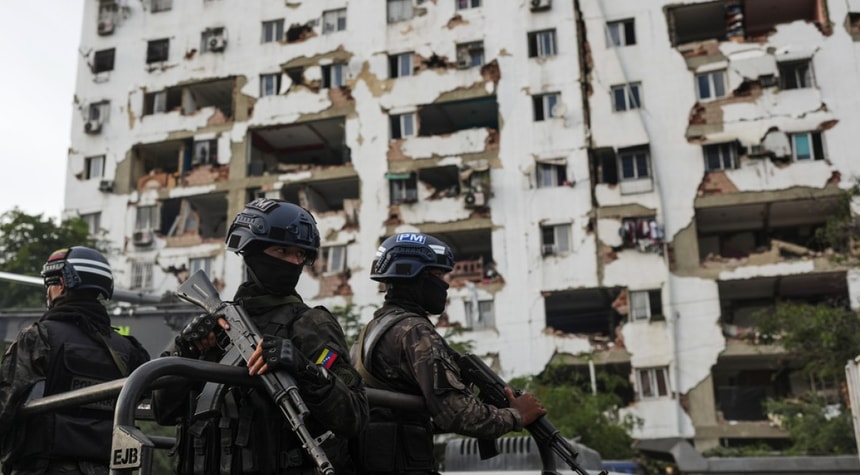
The capture of Nicolas Maduro and Venezuela’s subsequent alignment with the United States has fundamentally altered the security landscape in Latin America. What was once a sanctuary for armed insurgents has become hostile territory, and the National Liberation Army is learning this reality in the harshest terms possible.
Last month, Venezuelan forces conducted an airstrike against an ELN camp using American drones and intelligence. Nineteen people were killed in the operation. According to FundaRedes, a human rights organization monitoring the region, this marked the first Venezuelan military action against the ELN since Hugo Chavez assumed power in 1999. The significance of that quarter-century gap cannot be overstated.
The ELN has grown into the largest remaining left-wing guerrilla organization in Colombia and indeed throughout Latin America. This expansion occurred in large measure because of two factors. The first was the tolerance, if not outright cooperation, of the Maduro regime. The second was the power vacuum created by the collapse of the Revolutionary Armed Forces of Colombia. The ELN established bases on Venezuelan soil and developed a pattern of operations that proved devastatingly effective. Fighters would cross into Colombia, launch attacks against security forces, and then retreat across the border to safety.
Secretary of State Marco Rubio has made clear that this arrangement will no longer be tolerated. Speaking in September after meetings with Colombian President Abelardo de la Espriella, Rubio articulated the problem in direct terms. He described criminal gangs operating across borders, entering sovereign nations to commit murders and attacks, then fleeing to sanctuary in another country. Such a situation, he said, is not sustainable and must be addressed.
The characterization of the ELN as a political movement or guerrilla force with ideological aims is increasingly rejected by analysts who have studied the organization’s evolution. The group has transformed into what might more accurately be described as a criminal enterprise. Its activities center on terrorizing civilian populations, generating illegal profits, and causing harm. Whatever revolutionary pretenses may once have motivated its members have long since given way to the mechanics of organized crime.
Denying the ELN its safe haven represents a critical component of any strategy to dismantle the organization. The October strike demonstrated what trilateral cooperation among the United States, Colombia, and Venezuela can accomplish. With Venezuelan forces now willing to target ELN positions on their side of the border while Colombian forces press from the other direction, the organization faces pressure it has not experienced in decades.
The results of this intensified campaign are already evident. Since President de la Espriella took office on August 7, Colombian forces have dramatically increased offensive operations against ELN targets. Defense Ministry figures from the president’s first 90 days in office show a more than twelvefold increase in casualties compared to the first 90 days under former President Gustavo Petro. Nearly 300 ELN personnel have been killed, captured, or surrendered to Colombian forces alone.
The broader implications of Venezuela’s transformation extend well beyond the immediate tactical gains against a single insurgent group. For decades, Venezuela served as a destabilizing force in the hemisphere, providing support and sanctuary to organizations that threatened democratic governments throughout the region. That era appears to have ended. Whether this new cooperation can be sustained and expanded to address other regional security challenges remains to be seen, but the early indications suggest a dramatic realignment of interests in South America.
Related: Death Row Boxer Wins Magnitsky Award as International Community Presses Iran