
The United States military conducted precision strikes against Iranian anti-ship missile installations along the coastline near the Strait of Hormuz on Tuesday, employing some of the most powerful conventional weapons in the American arsenal.
U.S. Central Command confirmed that American forces successfully deployed multiple 5,000-pound deep penetrator munitions against hardened Iranian missile sites positioned along Iran’s coast. The operation specifically targeted facilities threatening one of the world’s most strategically vital waterways.
The Strait of Hormuz represents far more than a geographical feature on maritime charts. This narrow passage serves as the world’s most critical oil chokepoint, through which flows nearly one-fifth of global petroleum supplies. Any disruption to shipping through these waters carries immediate consequences for international energy markets and the broader global economy.
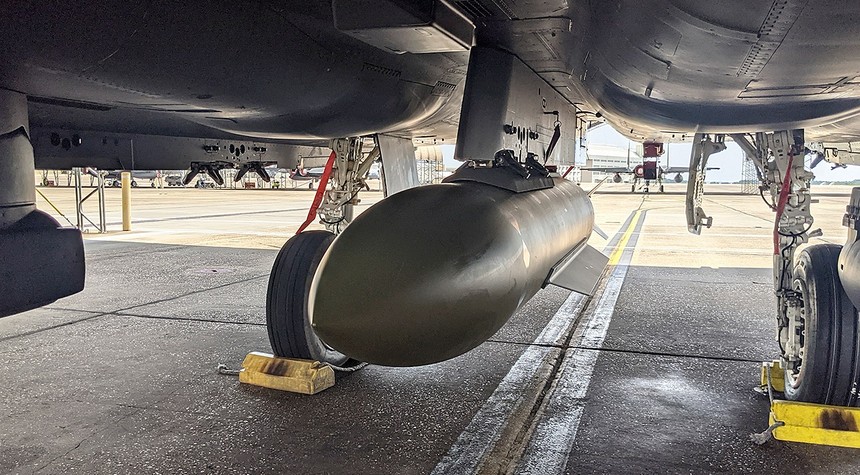
The selection of weaponry for this operation merits attention. The GBU-72 deep penetrator munitions, commonly known as bunker busters, represent specialized ordnance designed for a singular purpose: penetrating hardened or underground fortifications before detonation. These weapons do not merely strike surface installations. They burrow through reinforced concrete and earth to destroy targets that conventional munitions cannot reach.
The timing and nature of these strikes reflect growing American concern over Iranian activities in the region. Tehran has steadily expanded its military posture along the strait, positioning anti-ship missiles that pose direct threats to commercial and military vessels transiting these international waters. The Iranian regime’s willingness to threaten oil tankers has transformed what should be routine maritime commerce into a calculated risk.
President Donald Trump has undertaken diplomatic efforts to build international support for ensuring the strait remains open to global shipping. The challenge before the administration involves balancing military action with coalition building among nations that depend upon unimpeded access to Middle Eastern energy supplies.
The strategic calculus surrounding the Strait of Hormuz extends beyond immediate military considerations. Iran understands that its geographic position grants leverage over nations dependent upon Persian Gulf oil. The Islamic Republic has demonstrated willingness to exploit this advantage, whether through direct military action, proxy forces, or the implicit threat that missile batteries represent.
Tuesday’s strikes send an unambiguous message regarding American resolve. The United States possesses both the capability and determination to neutralize threats to international shipping lanes. The deployment of bunker-buster munitions specifically indicates that hardened installations offer no sanctuary from American military reach.
The broader implications of this operation remain to be seen. Iran faces a choice between escalation and recalculation. The regime in Tehran must now assess whether continued threats to commercial shipping justify the military costs that American forces have demonstrated they can impose.
For the international community, these developments underscore an uncomfortable reality. Freedom of navigation through critical waterways does not maintain itself through diplomatic declarations alone. It requires credible military power and the willingness to employ that power when vital interests face direct challenge.
The situation in the Strait of Hormuz will likely remain fluid in coming days as both Washington and Tehran evaluate their next moves in this high-stakes contest over one of the world’s most consequential pieces of ocean.
Related: Navy Deploys Wall-Climbing Robots to Combat Maintenance Delays as China Expands Fleet