
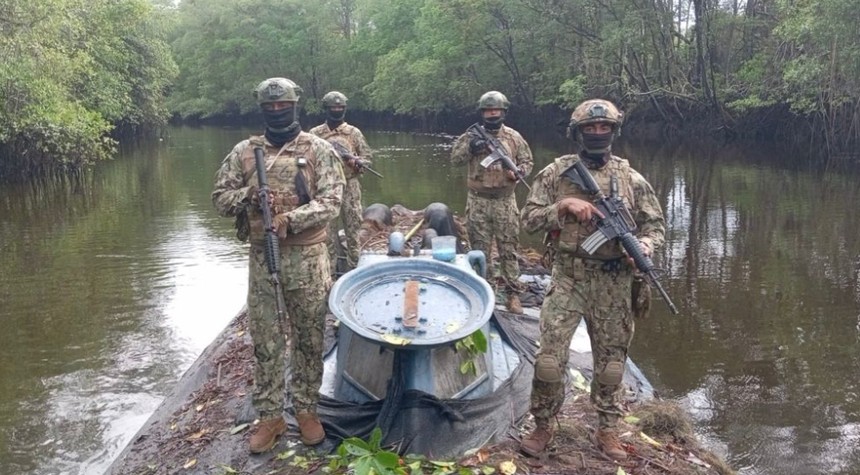
Ecuadorian military forces have successfully destroyed a sophisticated drug-trafficking submarine near the nation’s northern border, marking the opening salvo in expanded joint operations with the United States military aimed at dismantling organized crime networks that have plagued the South American nation.
The defense ministry in Quito announced Wednesday that military personnel discovered and neutralized what officials described as a “narco-submersible” measuring approximately 115 feet in length, concealed within the Cayapas-Mataje mangrove forest near Ecuador’s border with Colombia. The vessel, camouflaged with plant debris and positioned for what authorities believe was an imminent drug-running voyage, represents the kind of technological sophistication that has enabled criminal organizations to evade law enforcement across the hemisphere for years.
The United States Southern Command confirmed Tuesday that joint military operations with Ecuador had commenced, though the full scope and duration of these collaborative efforts remain undisclosed. What is clear is that both nations have determined the threat posed by narco-terrorism warrants direct military intervention.
The discovery of the submarine came during a military sweep of the remote coastal region, where personnel encountered armed resistance. Defense ministry officials reported that military forces came under fire upon locating the clandestine camp and returned fire, though casualties on either side have not been confirmed. This exchange underscores the dangerous reality facing those who would confront these criminal enterprises on their own territory.
The site yielded significant evidence of an extensive logistical operation. In addition to the submarine itself, military personnel recovered six speedboats, seven outboard motors, fuel supplies totaling more than 7,000 gallons, navigation equipment, and weaponry. These materials paint a picture of a well-funded, professionally organized criminal infrastructure capable of sustaining long-range maritime operations.
Ecuadorian President Daniel Noboa announced earlier this week that his government would pursue joint actions with international partners as part of a revised strategy against organized crime. This represents a significant shift in approach for a nation that has witnessed an alarming escalation in violence tied to drug trafficking and illegal mining operations.
The Cayapas-Mataje mangrove forest, where this operation unfolded, presents unique challenges for law enforcement. This dense coastal reserve contains some of the world’s tallest mangroves and proves extremely difficult to navigate, making it an ideal staging ground for criminal operations. Its proximity to the Colombian border creates a strategic corridor for drug trafficking organizations moving product toward Pacific routes.
These so-called narco submarines, which travel partially submerged rather than fully underwater, have become increasingly popular among international drug traffickers precisely because they can evade traditional detection methods. Their destruction represents more than the elimination of a single vessel; it signals a commitment to disrupting the supply chains that have allowed criminal organizations to operate with relative impunity.
Ecuador and the United States have maintained security cooperation for years, but the current wave of violence has demanded more aggressive action. The question now is whether these joint operations can achieve lasting results or whether they represent merely a temporary setback for organizations that have demonstrated remarkable resilience and adaptability.
What remains certain is that the citizens of Ecuador, who have endured terror, violence, and corruption at the hands of these criminal networks, deserve decisive action from their government and its allies.
Related: Iran Threatens Retaliation as Military Confrontation Extends Into Sixth Day