
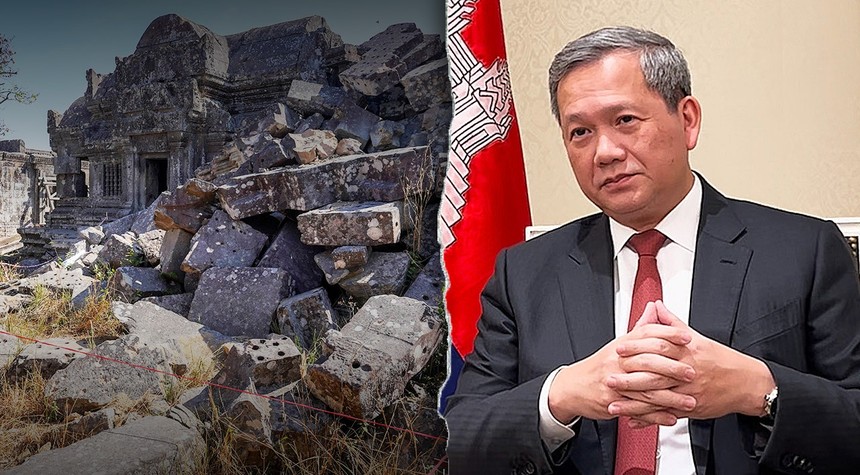
Cambodian Prime Minister Hun Manet has reported that Thai military forces have advanced into territory beyond even the contested border zones, effectively occupying land that both nations previously recognized as Cambodian-held.
In an interview conducted during his visit to Washington for President Trump’s Board of Peace initiative, Manet stated that Thai soldiers have sealed off entire villages using barbed wire and shipping containers, preventing approximately 80,000 Cambodian citizens from returning to their homes.
“The occupation is beyond even Thailand’s unilateral claim,” the Prime Minister said. “Many of the villagers cannot go back to their hometowns.”
The current situation represents a troubling development in what appeared to be a diplomatic success for the Trump administration. Last year, President Trump personally intervened to broker a ceasefire agreement between the two Southeast Asian nations during an ASEAN summit in Kuala Lumpur. At the time, the President characterized the achievement as evidence of American diplomatic capability, noting the rarity of being able to halt hostilities between two regional powers with direct intervention.
The Thailand-Cambodia border dispute has persisted for decades, rooted in colonial-era boundary determinations. The 500-mile frontier was largely demarcated during French colonial administration, but Bangkok and Phnom Penh have maintained conflicting interpretations of these historical boundaries. The disagreement has periodically erupted into armed conflict, particularly in areas surrounding ancient Khmer temple sites and rural villages where precise demarcation was never completed.
Fighting intensified last year, displacing thousands of civilians on both sides before the American-brokered ceasefire took effect. Recent reports and photographic evidence from the border region show structural damage to buildings near the frontier, including areas adjacent to the UNESCO-listed Preah Vihear temple complex. This has raised international concern about the preservation of irreplaceable cultural heritage sites caught in contested zones.
Cambodian officials have attributed the damage to Thai military operations. Thai officials have denied intentionally targeting religious or cultural landmarks, maintaining that military activities were confined to contested security zones. The Thai embassy did not respond to requests for comment regarding Manet’s statements.
The border conflict represents one of several territorial disputes in Southeast Asia where historical claims, national sovereignty, and regional stability intersect. The situation tests not only bilateral relations between Thailand and Cambodia but also the durability of American diplomatic engagement in the region.
Prime Minister Manet’s decision to raise these concerns during his visit to Washington suggests Cambodia’s expectation that American involvement in the original ceasefire carries with it ongoing responsibility for ensuring compliance. Whether the Trump administration will engage in renewed diplomatic efforts to address these allegations remains to be seen.
The displacement of 80,000 civilians, if confirmed, would represent a humanitarian concern requiring international attention beyond the immediate diplomatic and territorial questions at stake.
Related: María Corina Machado Credits Trump Administration for Historic Shift in Venezuela