
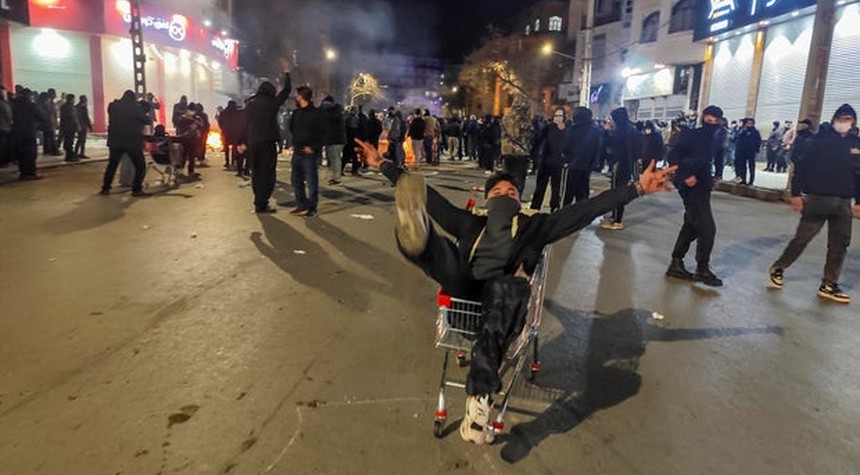
Thousands of Iranians took to the streets of Tehran and other major cities Thursday night in what represents the most significant challenge to the Islamic Republic’s authority in recent years. The demonstrations came in direct response to a call from the country’s exiled crown prince, Reza Pahlavi, who urged citizens to make their voices heard against the regime.
The protests, now entering their twelfth day, have resulted in approximately forty deaths and more than two thousand detentions by security forces. Despite these arrests and a nationwide blackout of internet and phone services, the unrest escalated dramatically Thursday evening, suggesting a resilience among demonstrators that has caught the attention of observers worldwide.
The extent of the upheaval remains difficult to assess with precision. The Iranian government’s systematic suppression of information flow has created a communications vacuum that makes independent verification challenging. What is clear, however, is that the regime views these demonstrations as a serious threat to its authority.
Supreme Leader Ayatollah Ali Khamenei, eighty-six, appeared on state television Friday morning in a defiant address that sought to project strength and continuity of control. The aging cleric accused President Trump of inspiring the protests and vowed that his government would “not back down.” He characterized the demonstrators as “a bunch of vandals” and pointed to the burning of a state television building in Tehran as evidence of foreign instigation designed to “please the U.S. president.” An audience before him responded with the familiar chant of “Death to America.”
The communications blackout, which continued Friday morning according to internet monitoring organizations, has forced the world to rely primarily on short video clips posted online by anti-regime activists. These fragments of footage provide the only meaningful window into the scope of the demonstrations sweeping the nation.
The protests appeared to intensify sharply at eight o’clock local time Thursday evening, the precise moment when Crown Prince Pahlavi had called upon Iranians to shout and chant from their windows in opposition to the regime. “Iranians demanded their freedom tonight,” declared Pahlavi, the son of Shah Mohammad Reza Pahlavi, who fled Iran just before the Islamic Revolution of 1979.
The current unrest represents a critical juncture for the Islamic Republic. The combination of sustained popular defiance, leadership from an exiled figure with historical legitimacy, and international attention creates a volatile mixture that the regime cannot easily dismiss or suppress through conventional means.
For American policymakers and international observers, these developments demand careful attention. The stability of the Middle East has long depended in part on the predictability, if not the desirability, of the Iranian government. A genuine popular uprising that successfully challenges the clerical regime would reshape regional dynamics in ways both promising and potentially perilous.
The coming days will prove crucial in determining whether these protests represent a genuine inflection point in Iranian history or another chapter in the long struggle between the Iranian people and their rulers. What remains beyond dispute is that the Iranian population has demonstrated a willingness to risk personal safety in pursuit of political change, a fact that no amount of official denial can erase.
Related: Thousands March in Colombia Against American Military Intervention