
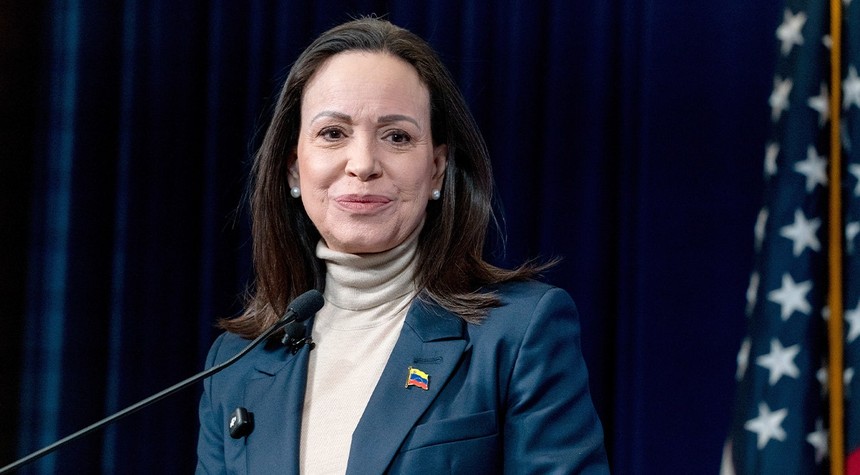
Venezuelan opposition leader María Corina Machado delivered a striking assessment this week of the political transformation unfolding in her nation, drawing parallels to one of the twentieth century’s most significant geopolitical events.
Speaking from Caracas, Machado characterized the collapse of the Maduro regime as “the equivalent to the fall of the Berlin Wall for the Americas,” crediting the Trump administration’s approach to Venezuela as instrumental in achieving this historic shift.
“This has been possible thanks to the courage and vision of President Trump,” Machado stated, expressing gratitude on behalf of the Venezuelan people. “As Venezuelans, we are very grateful for what he has done and are looking forward to moving along into building a democratic nation to which our children can come back.”
The opposition leader’s remarks underscore a moment of considerable consequence not merely for Venezuela, but potentially for the broader Western Hemisphere. Machado described the current situation as “once in a lifetime,” suggesting that the political realignment taking place in Caracas could establish precedents that extend well beyond Venezuelan borders.
The implications of Venezuela’s democratic transition, should it proceed successfully, would likely resonate throughout Latin America. Cuba and Nicaragua, both nations with authoritarian governments that have maintained close ties to the Maduro regime, would face new pressures as their regional ally undergoes fundamental political transformation.
For years, Venezuela has served as a cautionary tale of socialist governance gone catastrophically wrong. What was once South America’s wealthiest nation, blessed with the world’s largest proven oil reserves, descended into economic collapse, hyperinflation, and humanitarian crisis under socialist policies. Millions of Venezuelans fled their homeland, creating one of the largest refugee crises in the Western Hemisphere’s recent history.
Machado has positioned herself at the forefront of Venezuela’s democratic opposition, despite facing significant personal risk and government persecution. Her willingness to speak directly about the role of American leadership in facilitating Venezuela’s potential democratic restoration reflects a broader recognition among opposition figures that international pressure proved essential in weakening the Maduro government’s grip on power.
The Trump administration’s Venezuela policy represented a departure from previous approaches, combining economic sanctions, diplomatic isolation, and vocal support for democratic opposition figures. That strategy, while criticized by some international observers, appears to have contributed to the regime’s vulnerability.
As Venezuela contemplates its democratic future, Machado has indicated that preparations are underway for what she describes as potentially “the largest voluntary return” in history, as millions of displaced Venezuelans consider returning to their homeland.
The success or failure of Venezuela’s democratic transition will be watched closely throughout the Americas. A successful restoration of democratic governance and economic stability could indeed represent the watershed moment Machado describes, potentially inspiring democratic movements in other nations suffering under authoritarian rule.
For now, the Venezuelan people face the challenging work of rebuilding democratic institutions, restoring economic functionality, and healing a society fractured by years of political repression and economic hardship. Whether this moment truly parallels the fall of the Berlin Wall remains to be seen, but the optimism expressed by democratic opposition leaders suggests they believe a fundamental transformation is indeed at hand.
Related: American Naval and Air Forces Deploy to Middle East in Show of Strength Against Iran