
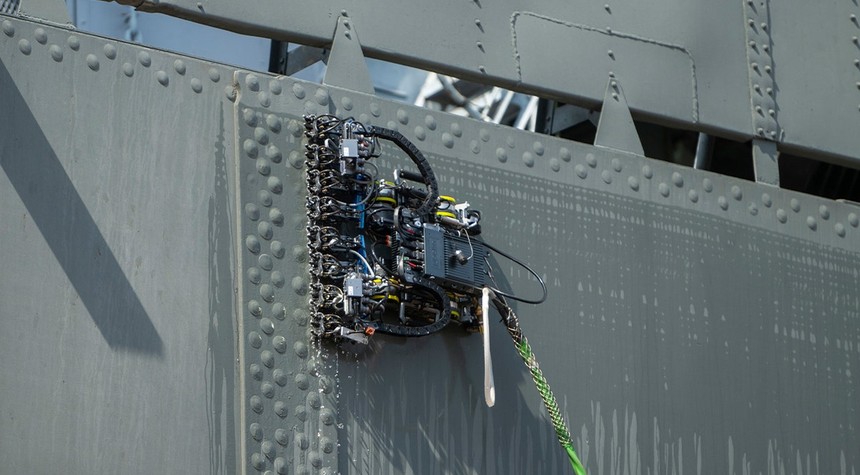
The United States Navy has awarded a five-year, $71 million contract to deploy wall-climbing robots across its Pacific Fleet in an effort to reduce maintenance delays that currently keep four out of every ten American warships sidelined.
The contract with Pittsburgh-based Gecko Robotics will initially focus on 18 vessels, with the award valued at up to $54 million. The program represents a significant shift in how the Navy approaches the persistent problem of fleet readiness at a time when America’s principal naval competitor continues to expand at an unprecedented rate.
Industry estimates indicate that only approximately 60 percent of U.S. Navy ships remain operational at any given time, with maintenance backlogs creating a substantial drain on available forces. This readiness crisis unfolds against a sobering strategic reality: China now operates between 370 and 390 warships and submarines compared with roughly 300 vessels in the American fleet. Perhaps more concerning, independent analyses suggest Chinese shipbuilding capacity exceeds that of the United States by more than 200 times when measured by tonnage output.
The Navy’s response to this challenge involves artificial intelligence and robotics, though not in the manner one might expect. Rather than deploying autonomous weapons systems, the service is turning to technology to solve the more mundane but equally critical problem of ship maintenance.
The AI-powered robots scale hulls, flight decks, and other difficult-to-access steel surfaces, scanning for corrosion, metal fatigue, and weld defects. Traditional inspection methods require sailors or shipyard workers to examine vessels point by point, often suspended on ropes or scaffolding. The robotic systems, by contrast, collect millions of data points and feed them into a digital platform designed to identify structural problems before they become critical failures requiring extended repair periods.
“Where value hasn’t improved, that’s where opportunity lives,” stated Justin Fanelli, Chief Technology Officer for the Department of the Navy. “Cracking the cost equation is just as important as cracking the physics equation. We’re now seeing solutions that make innovation adoption easier and in doing so save time, money and risk.”
The inspections will concentrate on destroyers, amphibious warships, and littoral combat ships, vessels that constitute essential components of U.S. naval operations throughout the Indo-Pacific region. This geographic focus reflects the strategic priority the Navy has placed on maintaining a credible presence in waters where Chinese naval expansion has been most pronounced.
Jake Loosararian, chief executive of Gecko Robotics, articulated the fundamental problem the technology aims to address. “It’s no good having 300 vessels if 40 percent of them are in a dry dock somewhere,” he noted.
The chief of naval operations has established a goal of achieving 80 percent fleet readiness, a target that would represent a substantial improvement over current levels. Whether robotic inspection systems can help reach that benchmark remains to be demonstrated, but the scale of the investment indicates the Navy’s conviction that traditional maintenance approaches have proven inadequate to the challenge.
The contract structure allows other military services to access the technology, suggesting potential applications beyond naval vessels. As American military planners confront the reality of a peer competitor with superior industrial capacity, such efficiency gains in maintenance and logistics may prove as strategically significant as advances in weapons technology itself.
Related: National Counterterrorism Director Resigns Over Iran War Policy