
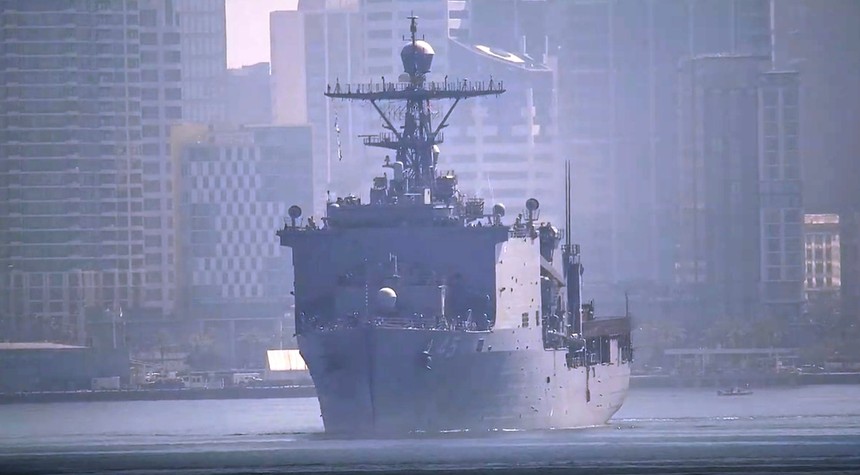
The United States military is positioning substantial additional forces in the Middle East, with nearly 9,000 Marines and sailors now either deployed or potentially redirected to the region as tensions with Iran continue to simmer.
Three Navy vessels departed San Diego earlier this week carrying the 11th Marine Expeditionary Unit, a force of 2,200 Marines and 2,000 sailors. While officially scheduled for deployment to the Indo-Pacific theater, military officials have indicated the ships’ likely destination is the Middle East. The USS Boxer, USS Comstock, and USS Portland comprise what is known as an Amphibious Ready Group, a flexible naval formation capable of projecting power across a wide spectrum of operations.
This deployment follows last week’s orders redirecting the 31st Marine Expeditionary Unit from Asia to the Middle East. That force is expected to arrive in the region by next week. Should the 11th MEU receive final orders for the Middle East, the combined deployment would represent a significant escalation in American military presence in this volatile region.
The timeline for such a deployment is measured in weeks, not days. The Boxer Amphibious Ready Group faces approximately two weeks of transit time to reach southeast Asia, followed by additional sailing time to the Middle East should final orders materialize. This deliberate pace underscores both the vast distances involved in modern military operations and the Pentagon’s methodical approach to force positioning.
Each Marine Expeditionary Unit brings considerable combat capability. These formations include ground combat forces, logistical support elements, and aviation units equipped with fighter jets, MV-22 Osprey tiltrotor aircraft, and attack helicopters. This combination provides commanders with options ranging from humanitarian assistance to full-scale combat operations.
The deployment has generated considerable speculation regarding potential missions. Military analysts have raised questions about whether these forces might be tasked with operations against Iranian interests, including possible action against Kharg Island in the Persian Gulf, which serves as a critical node in Iran’s oil export infrastructure. The Strait of Hormuz, through which roughly one-fifth of global oil supplies transit, remains another potential flashpoint where these forces could be employed.
For now, the Navy maintains that routine operations continue. The Third Fleet, which oversees naval operations in the Pacific, states the 11th MEU is conducting standard training exercises within its area of responsibility. Such training, the Navy notes, ensures warfighting readiness for forces operating throughout the Indo-Pacific region.
Yet the convergence of two Marine Expeditionary Units in the Middle East would be anything but routine. These are among America’s most versatile military formations, designed precisely for rapid response to emerging crises. Their deployment signals Washington’s determination to maintain credible military options as diplomatic efforts with Tehran remain strained.
The American people have seen this pattern before. Military forces position themselves, options are developed, and policymakers retain flexibility to respond to fast-moving events. Whether these forces will be called upon for action remains to be seen. What is certain is that American military power is once again flowing toward the Persian Gulf, and the world is watching.
Related: NATO Allies Refuse to Join Strait of Hormuz Military Operations