
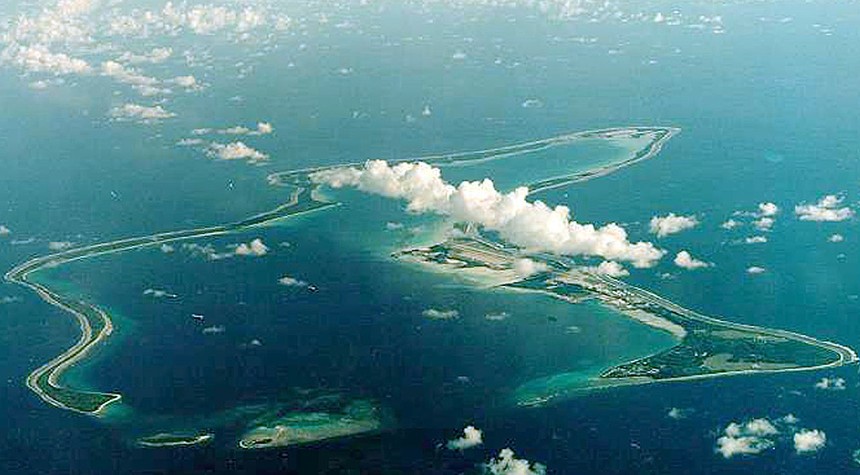
The strategic calculus of American military operations in the Middle East has shifted dramatically following an Iranian ballistic missile attack on a major United States installation in Bahrain, forcing the Pentagon to redirect critical logistics operations to the remote Diego Garcia base in the Indian Ocean.
The attack, which employed intermediate-range ballistic missiles, has demonstrated Iran’s expanding military capabilities and exposed the vulnerability of American coastal facilities in the region. In response, the Defense Department has established a maritime supply route stretching approximately 2,200 miles to Diego Garcia, a joint United States-British installation in the southern Chagos Archipelago.
The base, which hosts 2,500 American military personnel, has reportedly assumed a central role in supporting carrier strike groups, including the USS Abraham Lincoln. Forces operating from Diego Garcia have conducted air operations and assisted in enforcing the blockade of Iranian ports as the conflict continues.
James Tumbridge, an international lawyer serving as attorney general for the self-described Chagossian government-in-exile, characterized the logistical shift as evidence of the installation’s indispensable value to Western interests. The extended supply route, while requiring longer shuttle runs and slower replenishment compared to the compromised Bahrain facility, provides American forces with a secure staging area beyond the reach of Iranian missile systems.
“That is an inconvenience, but it shows the importance of the base,” Tumbridge stated. “The base is integral to regional security for the United Kingdom, United States and our allies. This latest news emphasizes it.”
The developments have intensified scrutiny of a proposed agreement that would transfer sovereignty of the Chagos Islands from Britain to Mauritius. Such an arrangement could potentially require American forces to seek permission from a third country for future operations at Diego Garcia, a prospect that defense analysts suggest would complicate rapid military responses in the region.
“Bahrain is a far easier target, so the United States change of supply arrangement makes sense,” Tumbridge observed, adding his hope that Britain’s new Prime Minister would not restrict American use of the facility. “It shows the importance of the base and asking a third country for permission is not what the United States will want, and so I hope this means Trump will still oppose the handover.”
The Iranian strike on Bahrain represents a significant escalation in Tehran’s willingness to target American military infrastructure directly. Intelligence assessments point to Iran’s Natanz nuclear facility and associated missile production capabilities as central concerns for Western military planners.
The situation has renewed calls for NATO allies to assume greater responsibility in securing the Strait of Hormuz, the vital waterway through which approximately one-fifth of global oil supplies pass. The strait’s security has become increasingly precarious as Iranian forces demonstrate both the capability and willingness to strike at American and allied positions throughout the region.
As the conflict develops, Diego Garcia’s role as an unsinkable aircraft carrier in the Indian Ocean has proven its worth once again, much as it did during previous Middle Eastern engagements. The question now facing policymakers in Washington and London is whether diplomatic agreements should be allowed to compromise access to such strategically vital real estate at a moment when its value has never been more apparent.
Related: British Petroleum Partners with Trump-Connected Firms for Venezuela Energy Project