
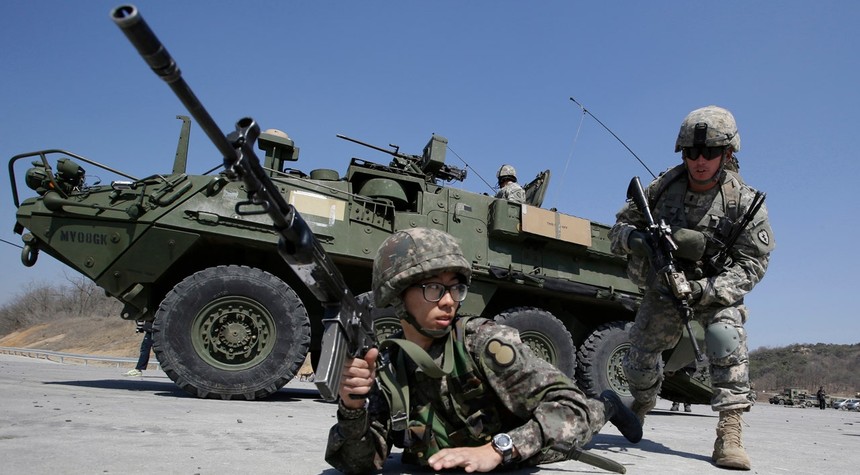
President Donald Trump directed the Pentagon on Sunday to reduce the scope of upcoming joint military exercises with South Korea, citing excessive costs and concerns about antagonizing North Korean leader Kim Jong Un. The decision comes amid renewed tensions on the Korean Peninsula, where Pyongyang recently conducted a test firing of a short-range ballistic missile.
In a statement posted to Truth Social, the president acknowledged that the timing prevented a complete cancellation of the scheduled drills but expressed dissatisfaction with the longstanding military cooperation agreement between Washington and Seoul. Trump indicated that his relationship with the North Korean leader factored significantly into his decision-making process.
“Based on my very good relationship with Kim Jong Un, of North Korea, I am not happy with the fact that the United States has, long ago, agreed to participate in Joint Military Exercises with South Korea,” the president wrote.
The announcement represents a significant shift in American military posture in East Asia, where joint exercises with South Korean forces have served as a cornerstone of regional security strategy for decades. These operations, designed to maintain readiness and demonstrate resolve against potential North Korean aggression, have traditionally involved thousands of troops and sophisticated military equipment.
The president’s statement also included criticism of South Korea’s decision not to participate in American military operations related to Iran’s nuclear program. This additional rebuke suggests growing friction in the bilateral relationship, despite the two nations’ formal alliance status.
Mark Montgomery, a senior fellow with The Foundation for Defense of Democracies, provided analysis of the situation, noting the complex timing of North Korea’s recent missile test in relation to ongoing American involvement in the Middle East.
The reduction in military exercises raises questions about America’s commitment to defending South Korea under the mutual defense treaty signed in 1953. Military analysts have long maintained that regular joint operations ensure both nations’ forces can effectively coordinate in the event of armed conflict on the Korean Peninsula.
North Korea has consistently demanded an end to these military drills, characterizing them as rehearsals for invasion. The Kim regime has historically used the exercises as justification for its own weapons development programs and military provocations.
The president’s emphasis on cost considerations reflects his broader approach to alliance relationships, wherein he has repeatedly called for partners to shoulder greater financial burdens for their own defense. This perspective has generated debate among defense policy experts about the proper balance between fiscal responsibility and strategic commitments.
The timing of this announcement, coinciding with North Korean missile activity, presents a diplomatic paradox. While the president seeks to avoid actions that might be perceived as provocative toward Pyongyang, the regime continues its weapons testing program regardless of American concessions.
South Korean forces participated in a Combined Distribution Exercise with the United States Army’s 2nd Infantry Division earlier this year in Pohang, demonstrating the operational integration that has developed between the two militaries over seven decades of cooperation.
The full implications of this policy adjustment remain to be seen, as do the responses from both Seoul and Pyongyang to this recalibration of American military presence on the peninsula.
Related: British Petroleum Partners with Trump-Connected Firms for Venezuela Energy Project