
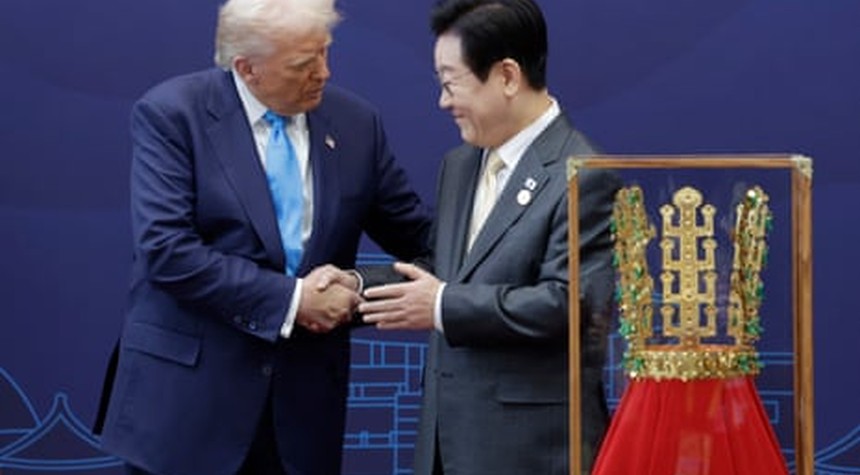
The United States and South Korea have reached a broad agreement on a substantial trade package worth $350 billion, South Korean officials announced Wednesday, as President Trump arrived in the region for the Asia-Pacific Economic Cooperation summit.
The agreement comes at a critical juncture in American trade policy, with the President scheduled to meet Thursday with Chinese leader Xi Jinping in their first face-to-face encounter of Trump’s second term. The meeting in Gyeongju, a southeastern Korean city, will likely determine the trajectory of US-China economic relations for the foreseeable future.
South Korean President Lee Jae Myung presented Trump with a golden crown replica from the ancient Silla kingdom during Wednesday’s proceedings, along with the Grand Order of Mugunghwa, South Korea’s highest civilian decoration. The symbolic gesture preceded the announcement of the trade framework, which South Korean officials described as a significant breakthrough in negotiations that had previously stalled.
“South Korea and the United States have reached an agreement on the details of the tariff negotiations,” Kim Yong-beom, an aide to President Lee, told reporters following discussions between the two leaders. The package comprises $200 billion in direct cash investment and $150 billion in shipbuilding cooperation, according to Kim’s statement.
President Trump confirmed the agreement’s existence but offered limited specifics during a dinner with Lee and other regional leaders. “We did reach a deal,” Trump stated. “We made our deal, pretty much finalized it.”
The South Korean agreement establishes important precedent as Trump prepares for what many observers consider the more consequential meeting with Xi. The President expressed optimism about reaching a comprehensive trade framework with China, suggesting he would reduce the 20 percent tariff currently imposed on Chinese goods connected to fentanyl precursor production.
“I think we’re going to have a deal,” Trump told reporters, characterizing the potential agreement as beneficial for both nations. Speaking before corporate leaders at the APEC summit, he added, “The world is watching, and I think we’ll have something that’s very exciting for everybody.”
The President’s Asia tour has featured a series of diplomatic victories and ceremonial honors. Prior to arriving in South Korea, Trump secured a rare-earths agreement with Japan’s new Prime Minister Sanae Takaichi during a Tokyo stopover. These developments suggest a broader realignment of Pacific trade relationships, with American interests positioned at the center of regional economic architecture.
The timing of these negotiations carries particular significance. Just two weeks before Trump’s departure, millions of Americans participated in domestic protests against his administration. Yet on foreign soil, the President has been received with considerable diplomatic deference, underscoring the complex realities of international relations where national interests often supersede internal political divisions.
The shipbuilding component of the South Korean deal deserves particular attention. American naval capacity has faced challenges in recent years, and substantial investment in shipbuilding cooperation could address critical gaps in maritime infrastructure while strengthening the US position in the Pacific theater.
Whether Thursday’s meeting with Xi produces similar results remains uncertain. The framework Trump described as already prepared for signature would represent a significant de-escalation in the trade tensions that have characterized US-China relations. However, the substance of any agreement will matter far more than its announcement, and the details will require careful scrutiny to determine whether American interests have been adequately protected.
The world is indeed watching, as President Trump noted. What unfolds in Gyeongju may well shape the economic landscape of the Pacific region for years to come.
Related: India Advances Legislation to Expand Worker Migration to Western Nations