
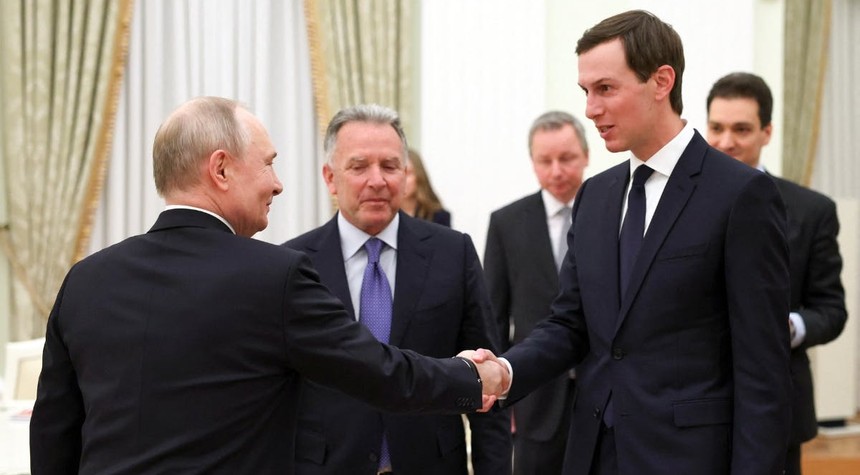
American envoys engaged Russian President Vladimir Putin in a marathon three-hour meeting Thursday night, pursuing what may prove to be the most significant diplomatic effort yet to end the war in Ukraine.
The delegation, consisting of Steve Witkoff and Jared Kushner, both confidants of President Trump, along with newly appointed Board of Peace senior advisor Josh Greunbaum, arrived for midnight talks as the World Economic Forum in Davos drew to a close. The Kremlin released video footage showing Putin, accompanied by foreign policy aide Yuri Ushakov and special envoy Kirill Dmitriev, greeting the American representatives before the substantive discussions began.
At the center of these negotiations lies a comprehensive 20-point peace plan designed to bring an end to the Russian invasion, now approaching its fourth year. The primary obstacle remains Moscow’s territorial demands in Eastern Ukraine, regions that Ukrainian forces have thus far successfully defended against Russian advances. The precise outcome of Thursday’s extended talks remained unclear in the immediate hours following the meeting’s conclusion.
The timing of this diplomatic engagement carries particular significance. Just hours before the Moscow meeting, President Trump characterized a potential settlement as “reasonably close,” while Witkoff indicated that resolution hinged on resolving a single remaining issue.
Earlier in the day, Trump met with Ukrainian President Volodymyr Zelensky at Davos, an encounter the President later described as “good” while speaking to reporters aboard Air Force One. The President’s remarks suggested a cautious optimism about the prospects for a negotiated settlement.
“We’re discussing things that have been discussed for six or seven months, and he came, and he said he wants to make a deal because I wasn’t necessarily sure. I think he should want to make a deal,” Trump stated. He added, “President Putin would like to make a deal. I think that President Zelensky would like to make a deal.”
The war in Ukraine has exacted an enormous toll since Russian forces invaded in February 2022. Hundreds of thousands of casualties on both sides, massive displacement of Ukrainian civilians, and profound disruption to global energy and food markets have made this conflict the most significant European military engagement since World War II.
The Trump administration’s willingness to pursue direct negotiations with Moscow represents a distinct shift in American diplomatic posture. Previous efforts to broker peace have foundered on fundamental disagreements about territorial integrity and security guarantees. The question of whether Ukraine will be required to cede any territory to Russia remains the most contentious element of any potential agreement.
For Ukraine, the stakes could not be higher. Any settlement must balance the immediate cessation of hostilities against long-term security concerns and territorial sovereignty. For the United States, the challenge lies in crafting an agreement that ends the bloodshed without appearing to reward military aggression or abandoning a democratic ally.
The international community now awaits further details about what transpired during those three hours in Moscow, and whether this latest diplomatic effort will finally produce the framework for peace that has proven so elusive.
Related: Trump Establishes Board of Peace at Davos Summit with Focus on Gaza