
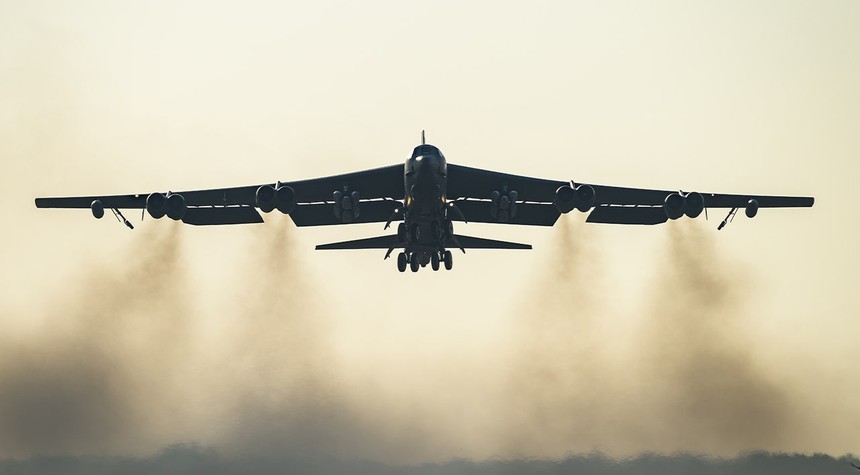
The deployment of B-52 strategic bombers over Iranian airspace marks a significant operational shift in what President Donald Trump has termed Operation Epic Fury, now in its thirty-second day. This development represents a clear indication that American military forces have achieved substantial air superiority over portions of the Islamic Republic.
General Dan Caine, Chairman of the Joint Chiefs of Staff, confirmed during a Tuesday briefing that the bomber missions commenced following marked increases in air superiority, allowing United States forces to expand operations within Iranian territory. The decision to deploy these aircraft, which lack the stealth capabilities of more modern platforms, signals confidence in the degradation of Iran’s defensive infrastructure.
President Trump addressed the nation Thursday evening, characterizing Iran’s air defense network as having been “annihilated” and describing American forces as “unstoppable.” The President stated that after more than a month of sustained operations, Iran “has been eviscerated and essentially is really no longer a threat.”
The B-52 Stratofortress, a Cold War-era aircraft that has served the United States Air Force for seven decades, brings considerable capabilities to this phase of operations. The bomber can carry up to seventy thousand pounds of ordnance, exceeding the payload capacity of any other bomber in the American arsenal. This allows for the delivery of mixed munitions, including precision-guided bombs and long-range cruise missiles, in single missions.
Mark Gunzinger, a retired Air Force colonel and former B-52 command pilot, explained that the aircraft’s presence over Iran constitutes clear evidence of American air superiority, and potentially air dominance, over portions of the country. The bomber’s ability to loiter over the battlefield enables forces to strike targets as they emerge, rather than relying exclusively on pre-planned, long-range attacks launched from outside contested airspace.
This operational flexibility represents a departure from the initial phase of the campaign, which focused on degrading fixed air defense installations through stand-off attacks. The slower speed and lack of stealth characteristics that typically would render the B-52 vulnerable in contested airspace underscore the extent to which Iranian defensive capabilities have been diminished.
However, military analysts caution that air superiority does not eliminate all threats. Iran retains missile and drone capabilities and has demonstrated throughout this conflict a willingness to employ asymmetric tactics despite substantial losses to its air defense network.
Meanwhile, Iran has denied claims that its military capabilities have been significantly weakened. Tehran’s official statements have contested American characterizations of the damage inflicted, though independent verification remains difficult given the ongoing nature of operations.
NATO allies have begun seeking diplomatic channels to address the closure of the Strait of Hormuz, a critical maritime chokepoint through which approximately one-fifth of global oil supplies transit. The strait’s status remains a significant concern for international commerce and energy markets.
The expansion of American air operations inside Iranian territory represents a potentially more intense phase of the campaign. The ability to conduct sustained, higher-volume strikes using heavy bombers suggests that military planners have moved beyond preliminary objectives and are now operating with considerably more freedom within Iranian airspace.
As this conflict continues, the international community watches closely, concerned both with regional stability and the broader implications for global security arrangements.
Related: Trump Says Iran Requested Ceasefire While Tehran Calls Statement Baseless