
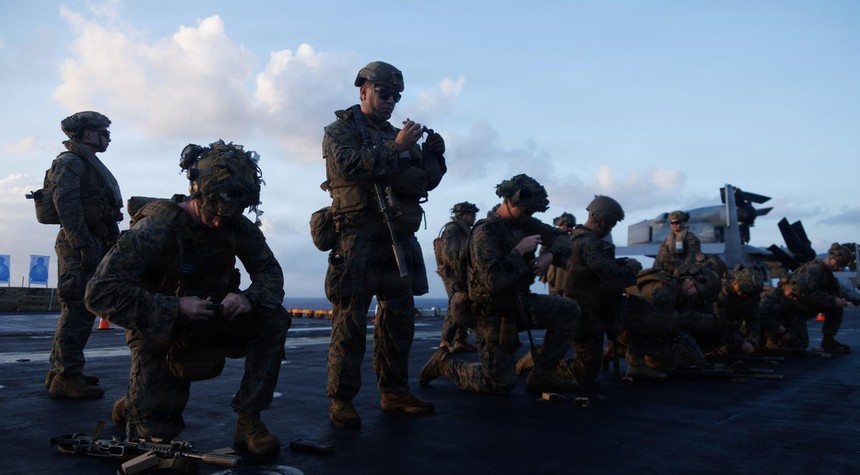
Hundreds of America’s most elite fighting forces have taken up positions across the Middle East, accompanied by thousands of Marines and Army paratroopers, in what represents a significant escalation of American military presence in the volatile region.
The deployment includes Navy SEALs and Army Rangers, alongside conventional forces numbering in the thousands. Sources familiar with the operational details indicate these forces provide President Trump with a range of military options should diplomatic efforts with Tehran fail. Among the possibilities under consideration are operations to forcibly reopen the Strait of Hormuz, seize control of oil facilities on Kharg Island, or capture Iran’s stockpile of enriched uranium.
The strategic waterway of the Strait of Hormuz remains a critical flashpoint. Through this narrow passage flows approximately one-fifth of the world’s oil supply, making its closure a matter of global economic concern and American strategic interest.
President Trump addressed the situation Monday morning, stating that his administration continues negotiations with Iranian leadership and expressing cautious optimism that an agreement might soon materialize to end hostilities now entering their fifth week. The conflict, launched jointly by American and Israeli forces on February 28, has steadily intensified despite periodic diplomatic overtures.
However, Iranian officials have consistently denied that any direct negotiations are currently underway. Tehran has characterized a fifteen-point ceasefire proposal from the White House as both excessive and unreasonable, casting considerable doubt on prospects for rapid diplomatic resolution.
In his same statement, the President issued a stark warning to Iranian leadership. Should an agreement not be reached shortly and the Strait of Hormuz remain closed, Trump indicated the United States would launch attacks against Iran’s electrical generating infrastructure, oil production facilities, and Kharg Island. He specifically noted these targets have been deliberately avoided thus far, adding that desalination plants might also be included in potential strikes.
The military buildup continues apace. More than 3,500 American troops arrived in the region over the weekend, including the USS Tripoli carrying approximately 2,500 Marines. Military officials confirmed Saturday that a second Marine Expeditionary Unit is en route to the theater of operations.
Additionally, elements of the 82nd Airborne Division are expected to deploy to the region. This contingent, numbering fewer than 1,500 service members, represents America’s rapid deployment force, capable of insertion anywhere in the world within hours of notification.
U.S. Central Command, responsible for military operations across the Middle East, declined to provide comment on the deployments or operational planning.
The situation presents the Trump administration with difficult choices. The economic consequences of a prolonged closure of the Strait of Hormuz would reverberate globally, potentially disrupting energy markets and international commerce. Yet military action against Iranian infrastructure carries its own risks, including the possibility of wider regional conflict and the humanitarian impact on Iran’s civilian population.
As this crisis enters its second month, the American people and the watching world await clarity on whether diplomacy or military force will ultimately determine the outcome. What remains certain is that American military might now stands ready in the region, prepared to execute whatever course the Commander-in-Chief ultimately chooses.
Related: NASA Shifts Strategy as China Advances Lunar Ambitions