
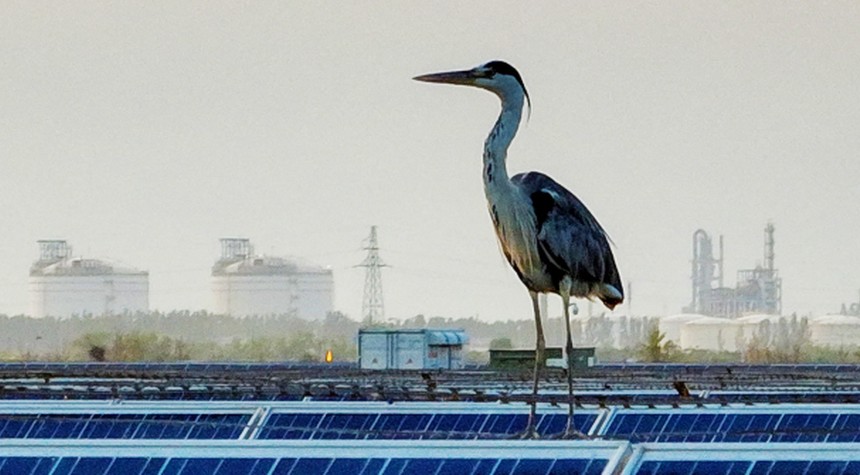
A comprehensive study published in Science has revealed significant environmental consequences from China’s aggressive expansion of solar energy infrastructure, documenting substantial reductions in bird diversity and habitat destruction across thousands of counties.
The research, conducted by scientists from China, Vietnam, and the United States, examined more than 2,000 Chinese counties and found a direct correlation between solar panel installation and declining bird populations. The primary cause, researchers determined, was land conversion—the transformation of agricultural land and environmental preserves into expansive solar farms.
The findings present a sobering reality check for renewable energy advocates. While the researchers acknowledged the importance of transitioning away from fossil fuels, they documented what they termed clean energy’s “large footprint on nature.” The data demonstrates that environmental benefits in one area can create significant environmental costs in another.
China’s solar infrastructure now covers an area equivalent to the state of Rhode Island. This rapid expansion, driven by Beijing’s centralized five-year planning system, has created what researchers describe as a “distinctive, quasi-experimental landscape” that made the environmental impact easier to study and more difficult to ignore.
The study identified several mechanisms through which solar installations harm bird populations. Most significantly, researchers documented a phenomenon they termed “inferior greening”—a paradox wherein solar panels actually promote vegetation growth, but only of a limited variety. This creates dense but ecologically homogenous plant life that proves useless to many bird species requiring diverse habitats for feeding, nesting, and shelter.
Beyond vegetation problems, solar farms fragment landscapes, create visual and thermal disturbances, and directly eliminate bird habitats through sheer physical displacement. The cumulative effect has been measurably detrimental to avian biodiversity in affected regions.
The researchers noted that some theoretical benefits exist. Solar panels create shaded, cooler, and more humid microclimates that can foster certain types of vegetation growth. In degraded areas, the physical structures might serve as “habitat islands.” However, the study found little evidence that these potential advantages have materialized in practice or provided meaningful benefits to displaced bird populations.
The United States Department of Energy has recently promoted “agrivoltaics”—attempting to maintain agricultural production, livestock grazing, and pollinator colonies beneath solar arrays. The Science paper suggests a different approach based on empirical evidence rather than optimistic projections. Researchers concluded that solar farms should be concentrated in deserts and other sparse terrain where vegetation is already limited and biodiversity impact would be minimized.
The Chinese case offers particular insights because of the speed and scale of development. Beijing’s centralized planning apparatus enabled rapid deployment of solar infrastructure, but that same system’s inflexibility prevented mid-course corrections when environmental problems emerged. The five-year planning model, characteristic of Communist governance, prioritizes meeting predetermined targets over adapting to inconvenient realities discovered during implementation.
This research arrives at a critical juncture for global energy policy. As nations worldwide accelerate renewable energy adoption, the Chinese experience provides valuable lessons about unintended consequences. The environmental movement has long promoted solar power as unambiguously beneficial, but the evidence suggests a more complex reality requiring careful site selection and honest assessment of tradeoffs.
The study underscores a fundamental truth often overlooked in energy policy debates: there is no such thing as impact-free power generation. Every energy source, including those labeled “clean” or “renewable,” creates environmental costs that must be weighed against environmental benefits. Sound policy requires acknowledging these realities rather than pretending they do not exist.
Related: Five Americans Among Seven Dead in Kenya Helicopter Accident