
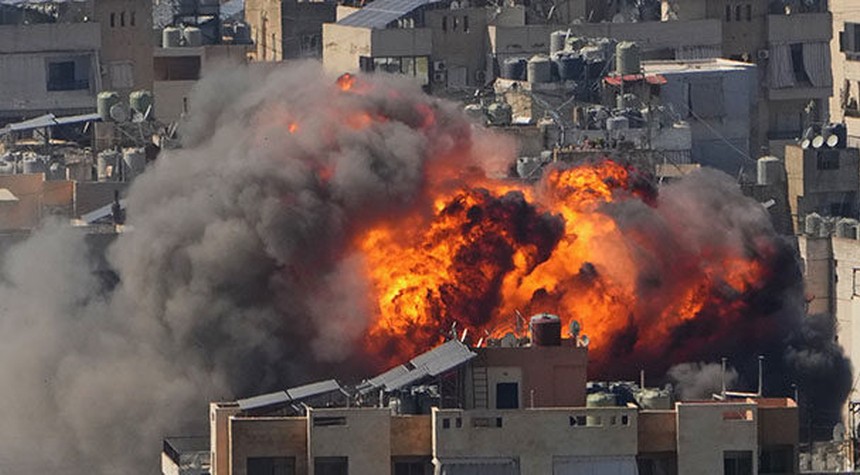
Israeli forces conducted a precision airstrike Sunday against senior commanders of Iran’s Quds Force operating from the Lebanese capital, marking a significant escalation in the effort to dismantle Tehran’s regional military infrastructure.
The Israel Defense Forces confirmed the strike targeted five key operatives of the Islamic Revolutionary Guard Corps’ elite foreign operations unit, including intelligence officers and financial coordinators who facilitated Iran’s support network for terrorist organizations throughout the region.
Among those targeted was Majid Hassini, identified as a senior financial operative responsible for coordinating Iranian payments to Hezbollah, Hamas, and other proxy forces. His elimination represents a substantial blow to the financial pipeline that has sustained Iran’s network of non-state actors across the Middle East.
The strike, which hit the Ramada Hotel in central Beirut, killed four individuals according to the Lebanese Health Ministry. Israeli military sources indicated that the operation specifically targeted intelligence and finance personnel who served as the critical link between senior Iranian leadership and Hezbollah’s command structure.
The Israeli military statement emphasized that these Quds Force commanders operated to advance terror attacks against Israeli territory and civilians while simultaneously coordinating broader Iranian Revolutionary Guard operations. The Lebanon Corps, as this unit is known, functions as the essential connection between the Iranian regime and Hezbollah, supporting the terrorist organization’s force development and strategic coordination.
This strike followed an unusual 24-hour warning issued by Israeli forces last Wednesday, directly addressing Iranian regime officials in Lebanon. The message was unambiguous: leave the country or face targeting wherever found. That Israel would issue such a public ultimatum speaks to the gravity with which Jerusalem views Iran’s direct military presence on its northern border.
The Israeli military noted that steps were taken to mitigate civilian casualties, including the use of precision munitions and aerial surveillance before executing the strike. Nevertheless, the operation highlights the complex challenge of targeting military personnel who, as the IDF statement noted, operate systematically within civilian populations, cynically exploiting non-combatants as human shields.
The Lebanese Health Ministry has reported 394 deaths from renewed hostilities between Israeli forces and the Iran-backed Hezbollah organization. The ministry claims 83 children and 42 women are among the deceased, though it makes no distinction between civilian casualties and Hezbollah military personnel in its count. The IDF maintains it has eliminated 200 Hezbollah militants, while the terrorist organization has not released its own casualty figures.
The broader context of this strike cannot be ignored. Hezbollah unilaterally dragged Lebanon into this conflict through rocket attacks against Israel, a decision that has drawn criticism from Lebanese officials who object to the terrorist organization’s seizure of their nation’s foreign policy. Lebanese Prime Minister Nawaf Salam declared all Hezbollah military activity illegal and forbidden, though the practical authority to enforce such a declaration remains questionable given Hezbollah’s dominant position within Lebanese territory.
What we are witnessing is the intersection of state and non-state warfare in the modern Middle East. Iran’s strategy of operating through proxy forces while maintaining deniability has long complicated regional security. This Israeli operation represents a direct challenge to that strategy, targeting not the proxies themselves, but the Iranian command structure that directs them.
The implications extend beyond this single strike. By targeting Iranian Revolutionary Guard commanders operating openly in Beirut, Israel has drawn a clear line regarding what it will tolerate along its borders.
Related: British Opposition Chief Warns of Diplomatic Crisis as Starmer Resists Backing US Operations