
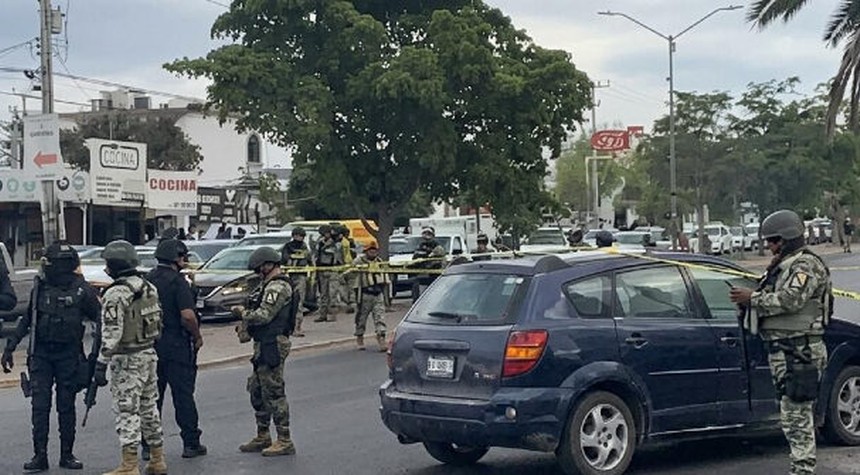
Good evening. In what can only be described as a stark illustration of Mexico’s deteriorating security situation, cartel gunmen brazenly attacked a funeral procession this week in Culiacan, Sinaloa, while Mexican Army soldiers stood by and did nothing to intervene.
The attack unfolded in broad daylight as mourners gathered for a funeral service in the heart of cartel territory. Two gunmen arrived in a sedan, exited their vehicle, and opened fire on the procession. The assault left two people dead and three wounded before the attackers returned to their vehicle and fled the scene.
What makes this incident particularly troubling is that a Mexican military vehicle was positioned directly alongside the funeral procession at the moment of the attack. Despite their proximity to the violence, the soldiers inside took no action to prevent the shooting or pursue the assailants. This inaction raises profound questions about the Mexican military’s rules of engagement and whether corruption has compromised their ability to protect civilians.
The timing of this attack is significant. Sinaloa has become the epicenter of a brutal territorial dispute between two competing factions of the Sinaloa Cartel. The violence has escalated dramatically in recent months, with civilians increasingly caught in the crossfire.
Adding to the gravity of the situation, Sinaloa’s governor, Ruben Rocha Moya, recently took leave from his position following a criminal indictment by the United States Department of Justice. The indictment names Rocha Moya and nine of his closest associates, accusing them of collaborating with the Sinaloa Cartel in exchange for bribes and political influence.
This development has created a political firestorm in Mexico City. Rocha Moya belongs to MORENA, Mexico’s ruling party, and maintains close ties to former President Andres Manuel Lopez Obrador, who serves as a mentor to current President Claudia Sheinbaum. The accusations against a sitting governor from the ruling party have exposed what many observers believe is systemic corruption at the highest levels of Mexican government.
President Sheinbaum has responded to mounting concerns by repeatedly asserting that crime rates are declining under her administration. These claims appear designed to deflect increasing pressure from Washington, where American officials have grown frustrated with Mexico’s apparent unwillingness or inability to confront the cartels effectively. The United States government has not only criticized Mexico’s anti-cartel efforts as insufficient but has also raised the possibility of direct American intervention.
The facts on the ground tell a different story than the one emanating from the presidential palace. When cartel members can execute civilians at a funeral while soldiers watch passively, it suggests a breakdown in the most fundamental responsibilities of government. When a state governor stands accused of working for the very criminal organizations his administration should be fighting, it indicates corruption has penetrated deep into Mexico’s political structure.
For American policymakers and citizens concerned about border security, these developments demand attention. The cartels operating with impunity just across our southern border represent not merely a Mexican problem but a direct threat to American national security interests.
That is the situation as it stands tonight in Sinaloa, where the rule of law appears increasingly subordinate to the rule of the gun.
And that is part of our world tonight.