
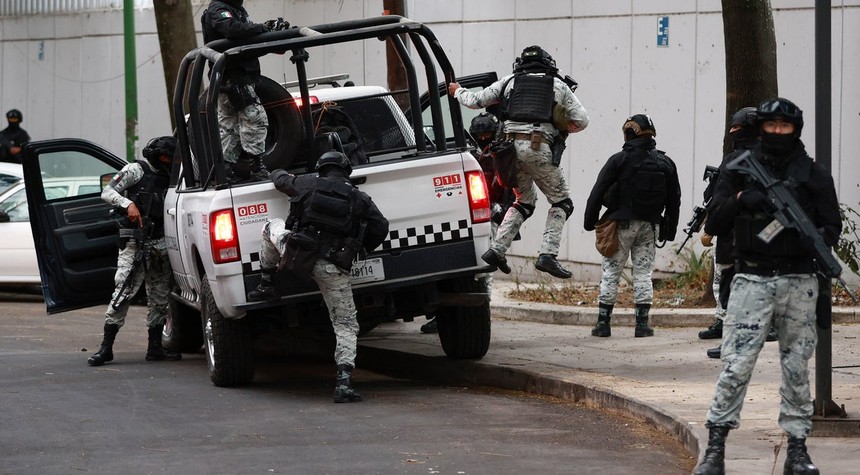
The killing of one of Mexico’s most notorious drug lords has plunged significant portions of the country into chaos, with cartel members launching coordinated attacks that have left dozens dead and prompted widespread shelter-in-place orders across multiple states.
Mexican Security Secretary Omar García Harfuch confirmed Monday that 25 members of the National Guard were killed in six separate attacks in Jalisco state following the death of Nemesio Rubén Oseguera Cervantes, known as “El Mencho,” the leader of the Jalisco New Generation Cartel. The cartel boss was killed during a shootout with Mexican military forces attempting to capture him at a location in his home state of Jalisco.
El Mencho had built one of the fastest-growing and most violent criminal networks in Mexico, an organization responsible for trafficking massive quantities of fentanyl, methamphetamine, and cocaine into the United States. His cartel had become notorious not only for its drug operations but for staging brazen attacks against government officials who dared to challenge its authority.
The operation that resulted in El Mencho’s death represents what sources describe as a new chapter in United States-Mexico counter-cartel cooperation. According to information provided to news organizations, the raid culminated months of intensified intelligence sharing between the two nations under Mexican President Claudia Sheinbaum’s administration. The cooperation has been channeled through newly emphasized joint interagency frameworks tied to United States Northern Command. Mexican special forces executed the mission while American personnel provided intelligence and operational guidance from outside Mexican territory.
The cartel’s response has been swift and brutal. Beyond the 25 National Guard members killed, the violence claimed the lives of a prison guard, a state prosecutor’s office agent, and an unidentified woman. García Harfuch reported that approximately 30 suspected cartel members were killed in Jalisco, with four additional deaths in neighboring Michoacan state. Cartel operatives blocked roads and set fire to vehicles across the country in coordinated acts of intimidation.
The scope of the disruption became clear as Mexican authorities worked to dismantle more than 250 cartel roadblocks that had been erected across 20 states. Several states canceled school on Monday, and both local and foreign governments issued warnings urging citizens to remain indoors as the violence unfolded.
The United States Embassy ordered personnel in eight cities and throughout Michoacan state to shelter in place and work remotely Monday. American citizens throughout many parts of Mexico received similar warnings. In Puerto Vallarta, taxi and rideshare services were suspended entirely as authorities worked to restore order.
Guadalajara, Mexico’s second-largest city and the capital of Jalisco state, was virtually paralyzed Sunday as residents remained in their homes. More than 1,000 people found themselves stranded overnight at the city’s zoo, sleeping in buses under police protection. By Monday morning, as mothers wrapped in blankets carried their children from the buses for bathroom breaks, the city showed tentative signs of returning to normal activity, with vehicles beginning to circulate in the pre-dawn hours.
President Sheinbaum urged calm and was expected to address the situation in detail during her regular morning briefing. Mexican officials had hoped that eliminating the world’s most prolific fentanyl trafficker would demonstrate their commitment to combating the cartels and ease pressure from the Trump administration to take more aggressive action. However, as residents remained on edge awaiting potential further cartel retaliation, the ultimate cost of this victory remained uncertain.
The events underscore the continuing challenge Mexico faces in confronting powerful criminal organizations that have grown wealthy and bold through the drug trade with the United States.
Related: Russia Launches Massive Aerial Assault on Ukrainian Infrastructure