
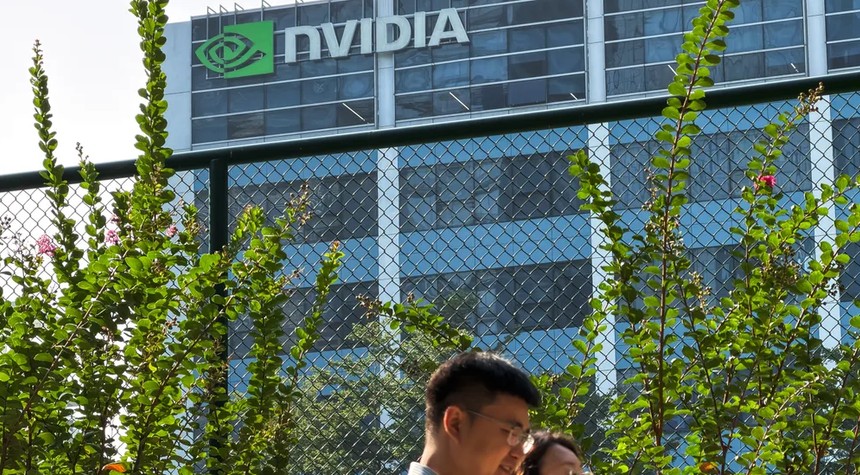
The gateway through which China has accessed America’s most advanced artificial intelligence technology has been significantly constricted, though questions remain about whether these new restrictions can be effectively enforced.
Nvidia, the dominant manufacturer of AI processing chips, has implemented an informal policy limiting Chinese customers to no more than 49 percent of sales among companies that lease its computing power. The restriction, communicated through verbal agreements rather than written contracts, represents an attempt to prevent Chinese firms from utilizing American data center infrastructure to develop their own artificial intelligence systems.
The company’s rationale reflects the Trump administration’s broader technological competition with Beijing. An Nvidia spokesperson emphasized that America’s success in what the President has termed the “Super Intelligence” race depends on maintaining global dominance in AI infrastructure. The term “Super Intelligence” became official government nomenclature last September when President Trump signed an executive order titled “Inaugurating the Era of Super Intelligence.”
The spokesperson articulated the strategic concern plainly: if the world’s cloud computing systems depend on foreign-manufactured chips, the resulting AI models and applications will inevitably be developed abroad as well.
These verbal restrictions apply to new contracts with Nvidia clients worldwide, though the company has declined to officially confirm the policy’s existence. Sources familiar with the matter indicate Nvidia began issuing these informal directives during the summer months, anticipating criticism over its dealings with Chinese entities.
The company has simultaneously developed what insiders describe as a “white list” that reduces its Asian client base by more than half. Yet implementation faces practical obstacles. Industry representatives in Singapore have noted the difficulty of identifying sufficient non-Chinese clients outside the United States, suggesting that strict enforcement could damage Nvidia’s business interests.
The stakes are substantial. Chinese technology giants ByteDance, Alibaba, and Tencent have collectively requested more than three million RTX Pro 5500 chips from Nvidia, representing approximately 35 billion dollars in potential sales. The order exceeds Nvidia’s current production capacity, rendering fulfillment impossible regardless of policy restrictions.
American security agencies have taken note of these developments. A joint cybersecurity advisory issued in September by the National Security Agency, the Cybersecurity and Infrastructure Security Agency, and the Federal Bureau of Investigation urged American AI companies to identify malicious actors attempting to extract proprietary model data.
The broader context reveals long-standing American policy encouraging global data centers to operate on United States semiconductor technology. This approach has enabled American AI companies to maintain competitive advantages internationally. However, the informal nature of Nvidia’s new restrictions raises questions about enforceability and consistency.
Neither the Chinese Embassy in Washington nor the Commerce Department provided comment on these developments.
The situation illuminates the complex relationship between commercial interests and national security concerns in the technology sector. While restricting Chinese access to advanced computing power serves strategic objectives, the global nature of the semiconductor industry and the immense demand from Chinese firms create powerful economic incentives that work against such limitations.
As artificial intelligence continues advancing at unprecedented speed, the tension between maintaining technological superiority and participating in profitable global markets will likely intensify for American chip manufacturers.
Related: Ukraine Warns of Imminent Russian Attack Timed to American Election Day