
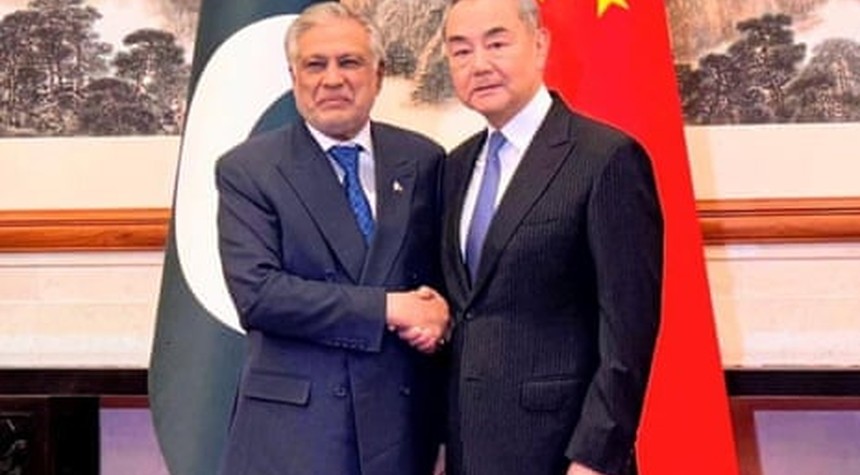
Pakistan and China issued a joint five-point proposal for peace in the Middle East following a hastily arranged meeting between foreign ministers in Beijing on Tuesday, as Pakistan continues its ambitious effort to position itself as the primary mediator in the ongoing conflict between the United States and Iran.
Foreign Minister Ishaq Dar traveled to the Chinese capital seeking support for Pakistan’s faltering diplomatic initiative, meeting with his counterpart Wang Yi in what both nations characterized as an effort to strengthen cooperation on the crisis. The meeting produced a joint statement calling for an immediate ceasefire and the protection of vital waterways, including the strategically critical Strait of Hormuz, through which much of the world’s oil supply passes.
China’s involvement represents a measured but significant development in the diplomatic landscape surrounding this conflict. Beijing has maintained what can only be described as a studied distance from the crisis, despite maintaining substantial ties with Tehran and serving as the largest purchaser of Iranian oil. After condemning the initial American and Israeli strikes on Iran, China has since adopted a position of apparent neutrality, focusing primarily on securing safe passage for its oil tankers through the contested strait while calling generally for a ceasefire.
The joint statement emphasized that dialogue and diplomacy remain “the only viable option to resolve conflicts,” though there appears to be little concrete progress in bringing the principal parties to the negotiating table. The diplomatic picture remains clouded by contradictory statements from the warring parties themselves. President Trump claimed this week that negotiations with Iran are proceeding “extremely well,” while Tehran flatly denies that any direct talks are occurring.
Pakistan’s push for a central role in these peace efforts comes after years of being marginalized by Washington under previous administrations. Prime Minister Shehbaz Sharif and Army Chief Syed Asim Munir have been conducting an extensive diplomatic campaign, communicating directly with President Trump and Iranian President Masoud Pezeshkian, as well as dozens of other world leaders. Pakistani intermediaries have reportedly been passing messages between the two adversaries.
On Sunday, Islamabad hosted talks with the foreign ministers of Saudi Arabia, Turkey, and Egypt in an attempt to forge a regional solution to the conflict. However, the absence of American and Iranian representatives significantly undermined the diplomatic weight of these discussions.
Analysts suggest that Pakistan’s energetic embrace of the mediator role stems from both its desire to reclaim relevance in Washington and the current government’s ambition to establish the country as a regional diplomatic power. The involvement of Army Chief Munir in these efforts is particularly noteworthy, reflecting the military’s continued influence in Pakistani foreign policy decisions.
The five-point peace initiative, while light on specific details in the public statement, represents the most formal diplomatic product to emerge from Pakistan’s mediation efforts thus far. Whether it will gain traction with the parties actually engaged in the conflict remains to be seen.
What is clear is that the war shows little sign of abating, and the diplomatic efforts, however well-intentioned, have yet to produce substantive progress toward ending the hostilities. The international community watches and waits, hoping that dialogue will prevail over continued military action.
Related: Netanyahu Orders Expansion of Israeli Ground Operations in Southern Lebanon