
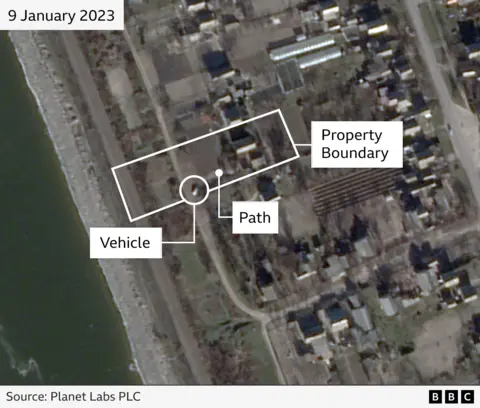
From the peaceful banks of the Kakhovka reservoir to a militarized zone under Russian control, the Ukrainian village of Verkhnya Krynytsya stands as a testament to the devastating transformation wrought by war. Recent satellite imagery reveals the stark changes in this once-tranquil community, where new military access roads now cut through familiar landscapes and childhood memories.
The village, whose name poetically translates to “Upper Spring,” fell under Russian occupation shortly after the February 2022 invasion. Satellite documentation shows the emergence of a well-worn road in the summer of 2022, leading directly to what was once a civilian residence. The path’s continued use through the winter of 2023 suggests sustained military activity in an area that previously knew only the quiet routines of rural life.
Before the invasion, Verkhnya Krynytsya was home to more than a thousand residents, primarily retirees who had chosen to remain in their ancestral community while younger generations sought employment elsewhere. The village’s position along the vast Kakhovka reservoir, locally known as “the Sea,” provided both sustenance and recreation for generations of inhabitants.
The outbreak of hostilities brought immediate changes. Ukrainian authorities distributed 43 Kalashnikov rifles to the village for self-defense, though residents collectively decided against armed resistance. This decision did not spare them from the occupation’s harsh realities. Local leadership faced severe consequences, as evidenced by the capture and reported torture of village head Serhiy Yavorsky by Russian forces.
The occupying forces quickly established strategic positions, converting a local sewage treatment facility into a military command post. The transformation extended beyond military installations to impact the very geography that defined the village. The destruction of the Kakhovka dam in June 2023 drained the reservoir that had been central to community life, erasing a natural landmark that had shaped local culture and tradition for generations.
Where children once swam in summer waters and winter ice-fishermen gathered, only empty shoreline remains. The loss of “the Sea” represents more than a geographical change; it marks the erasure of a cultural touchstone where Ukrainian folk songs once echoed across evening waters, creating memories that sustained community identity through generations.
This fundamental alteration of both landscape and daily life in Verkhnya Krynytsya illustrates the profound impact of the Russian invasion on Ukraine’s rural communities. What was once a peaceful agricultural village has become another strategic point on a map of conflict, its transformation visible from space but felt most deeply by those who once called it home.
And that’s the way it is in occupied Ukraine, where the wounds of war continue to reshape both the physical and human landscape of a nation under siege.