
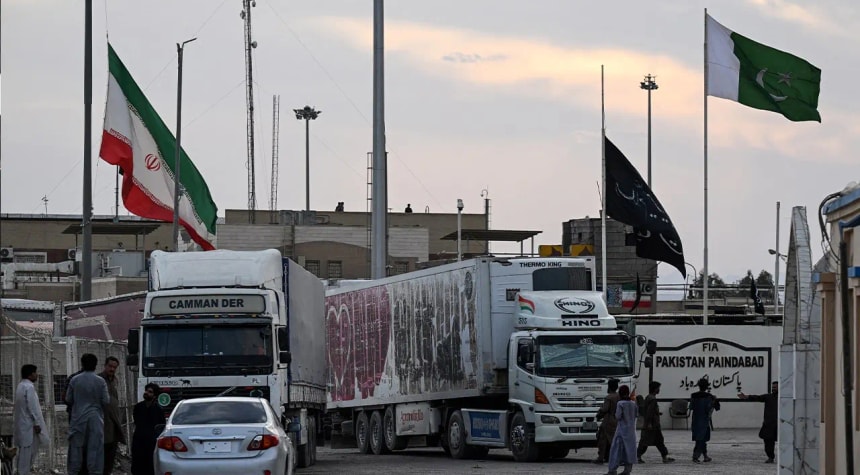
President Donald Trump is maintaining his strategy of economic pressure against Iran following last week’s midterm elections, despite indications that the ongoing conflict contributed to Republican losses at the ballot box. The administration has announced an expanded effort to restrict Iranian access to land and Caspian Sea trade routes, which Tehran has increasingly relied upon to circumvent the American naval blockade.
The new initiative, designated Task Force Iron Gate, addresses a persistent vulnerability in the existing pressure campaign. While American warships have successfully limited Iran’s maritime access, overland routes through neighboring countries and transportation across the Caspian Sea have remained available for the movement of goods, dual-use technology, and military supplies into Iranian territory.
The task force, comprising approximately twenty personnel stationed at United States Central Command headquarters in Tampa, represents what experts describe as a coordination center rather than a deployable military unit. Farzin Nadimi, a senior fellow at the Washington Institute for Near East Policy, characterized Iron Gate as a fusion cell designed to coordinate military, civilian, and intelligence efforts across multiple agencies and international partners.
The immediate focus appears to center on intelligence gathering along Iran’s borders and fostering regional cooperation to support sanctions enforcement and interdiction efforts. Secretary of State Marco Rubio has emphasized that the administration views economic measures as preferable to military escalation, stating that Washington need not conduct military strikes if economic pressure achieves similar objectives.
Rubio rejected characterizations of the current situation as a stalemate, arguing that combined pressure from sanctions, the naval blockade, and other measures continues to weaken Tehran’s position. He described Iran as bleeding economically, with pressure mounting daily.
The timing of this escalation is noteworthy given the political landscape following the midterm elections. According to exit polling data, the Iran conflict factored significantly in voting decisions for thirty-four percent of voters, with approximately six in ten respondents indicating they believed military action against Iran was the wrong decision. Separate polling conducted around Election Day found sixty-eight percent of Americans considered avoiding prolonged military conflict in Iran very important.
Four days after the election results, CENTCOM announced Task Force Iron Gate would coordinate efforts to disrupt the movement of advanced weapons, dual-use technologies, sanctioned materials, and illicit revenue across Iran’s land borders and the Caspian Sea. Admiral Brad Cooper, the CENTCOM commander, stated the United States would not permit the Iranian regime to rebuild weapons facilities or replenish arsenals with smuggled materials.
The operational challenge is substantial. Iran shares land borders with seven countries: Afghanistan, Armenia, Azerbaijan, Iraq, Pakistan, Turkey, and Turkmenistan, spanning roughly six thousand kilometers. Dozens of official border crossings exist, and mountainous and desert terrain provides additional routes for smuggling operations beyond official checkpoints.
The task force’s effectiveness will depend significantly on cooperation from governments neighboring Iran. Turkey and Pakistan have reportedly already imposed some limitations on goods crossing their borders with Iran, contributing to delays and increased shipping costs. However, Iran and the Islamic Revolutionary Guard Corps are expected to seek alternative methods to circumvent restrictions.
Behnam Ben Taleblu, senior director of the Iran program at the Foundation for Defense of Democracies, cautioned against judging the effort by whether it completely eliminates Iranian overland trade. The objective, he explained, is to increase costs, pressure foreign entities facilitating Iranian commerce, and provide Washington with additional leverage in future negotiations.
These land routes have grown increasingly important as other Iranian access points to international trade have contracted. Iran’s missile program remains dependent on foreign inputs including fuel precursors and high-strength steel, with China and Russia serving as major suppliers. Iraq, Turkey, and Pakistan represent significant regional corridors for such materials.
Analysts predict this will be a medium to long-term undertaking. Nadimi suggested Iran may initially respond more aggressively as economic pressure intensifies. The administration appears prepared to maintain this approach despite domestic political costs, calculating that sustained economic pressure represents the most viable path forward in dealing with Tehran. Whether this strategy produces the desired diplomatic breakthrough or leads to further escalation remains to be seen.
Related: Pontiff Appeals for Healthcare Access and Social Equality During Uruguay Visit