
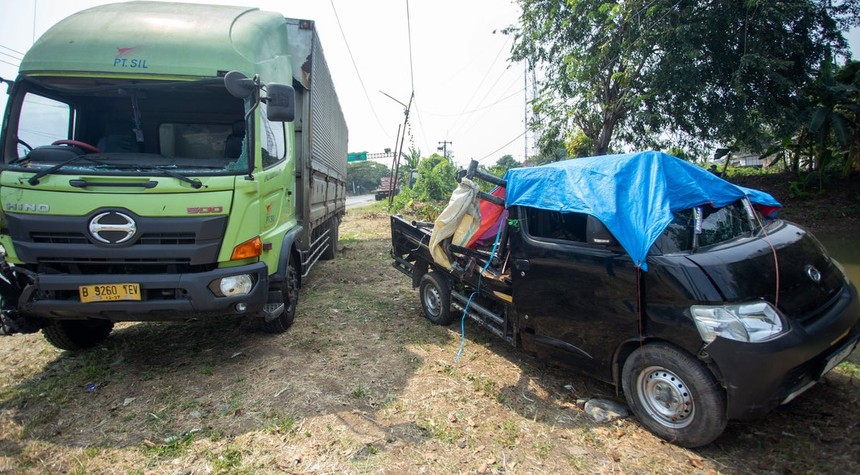
Thirteen people lost their lives and five others sustained injuries when a pickup truck carrying wedding guests was crushed between two larger trucks on a highway in Indonesia’s Java province, according to local police authorities.
The accident occurred Sunday afternoon on the northern coastal highway near Kiajaran Kulon village in Indramayu regency. The victims were returning home following a wedding celebration in the neighboring village of Parean when tragedy struck on what should have been a joyous occasion.
Local traffic police chief Undang Syarif Hidayat provided details of the collision’s sequence. The wedding party was traveling in an open-bed pickup truck when the driver slowed the vehicle and stopped near a median opening to execute a U-turn on the highway. At that moment, a wing-box truck traveling in the same direction struck the pickup from behind.
The force of that initial impact propelled the pickup truck into the opposite lane of traffic, where it was struck a second time by an oncoming truck. The dual collision proved catastrophic. More than a dozen passengers were thrown from the pickup bed onto the highway pavement.
Five individuals survived the accident and remained hospitalized as of Monday, with injuries ranging from minor to serious in nature. Authorities have launched an investigation to determine the precise cause of the crash.
This tragedy underscores a persistent and troubling pattern across Indonesia. Deadly traffic accidents occur with alarming frequency throughout the archipelago nation, a reality that reflects deeper systemic failures in transportation safety and regulatory enforcement.
Several factors contribute to Indonesia’s poor road safety record. Overloaded vehicles remain commonplace on Indonesian roads, exceeding weight and passenger capacity limits with little consequence. The open-bed pickup truck involved in Sunday’s accident exemplifies this practice, carrying more than a dozen passengers in a vehicle configuration offering minimal protection.
Inadequate road safety measures compound the human factors. Highway infrastructure often lacks proper barriers, lighting, and warning systems that might prevent or mitigate such accidents. The median opening where the pickup attempted its U-turn represents the kind of design feature that can create dangerous conflict points on busy highways.
Poor compliance with traffic regulations constitutes perhaps the most significant challenge. Enforcement of existing safety laws remains inconsistent, and cultural attitudes toward traffic rules have been slow to evolve alongside the nation’s rapid motorization.
Indonesia’s economic development has brought increased vehicle ownership and expanded road networks, but safety infrastructure and regulatory systems have not kept pace with this growth. The result is a mounting toll of preventable deaths on the nation’s roads.
For the families of the thirteen victims, Sunday’s crash transforms what should be cherished memories of a wedding celebration into an enduring tragedy. Their loss serves as a sobering reminder that Indonesia’s road safety crisis demands urgent attention and meaningful reform.
As investigators work to determine the specific circumstances that led to this particular accident, the broader pattern remains clear and demands a comprehensive response from Indonesian authorities at all levels of government.
Related: Deadly Wildfire in Spanish Tourist Region Kills at Least Twelve