
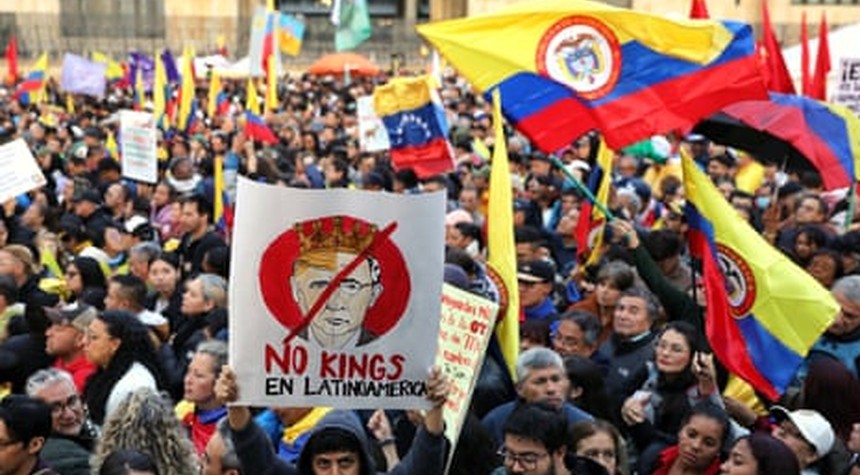
Thousands of Colombian citizens marched through their nation’s cities Wednesday in organized protests against potential American military intervention, following President Trump’s statements suggesting interest in military operations on Colombian territory.
The demonstrations, called for by Colombian President Gustavo Petro, came in response to last weekend’s special forces operation in Venezuela that resulted in the capture of President Nicolás Maduro and First Lady Cilia Flores. The raid on a military base in Caracas left dozens of Cuban and Venezuelan security personnel dead.
In Cúcuta, a border city adjacent to Venezuela, several hundred demonstrators processed toward the city’s nineteenth-century cathedral, carrying Colombia’s national colors and chanting against American presence. The protests reflected deep-seated concerns about sovereignty and the specter of foreign military action on South American soil.
The situation presents a complex diplomatic challenge. President Petro publicly declared the Venezuelan operation illegal during remarks to supporters gathered at Bolívar Plaza in Bogotá. Yet shortly before his public statement, Petro engaged in his first telephone conversation with President Trump, after which the American president characterized the exchange as productive on his social media platform.
This duality in approach reveals the delicate position in which Colombia now finds itself. The nation must balance its relationship with the United States, a crucial ally and trading partner, against domestic political pressures and regional solidarity concerns. Petro’s statement that “we cannot lower our guard” while simultaneously expressing willingness to meet with Trump demonstrates this careful navigation.
The Venezuelan operation itself represents a significant escalation in American involvement in South American affairs. The successful extraction of a sitting head of state from his capital city marks an unprecedented action in the hemisphere’s modern history. Whether one views Saturday’s raid as a legitimate response to a failing authoritarian regime or as an overreach of American power depends largely on one’s perspective regarding intervention and sovereignty.
For Colombia, the stakes are particularly high. The nation shares an extensive border with Venezuela and has absorbed millions of Venezuelan refugees in recent years. Any expansion of military operations into Colombian territory would directly impact its citizens and potentially destabilize border regions already strained by the Venezuelan crisis.
The protests Wednesday revealed genuine popular concern about American intentions. Demonstrators expressed views ranging from measured opposition to military intervention to more heated denunciations of American policy. This range of sentiment reflects broader questions about the appropriate role of American power in addressing regional challenges.
President Trump’s characterization of himself as “the president of peace” stands in stark contrast to the military action his administration authorized in Caracas. This contradiction has not gone unnoticed by observers in Latin America, where historical memory of American intervention runs deep.
The coming days will prove critical in determining whether diplomatic channels can address the concerns of both nations. President Petro’s indication of willingness to meet with Trump suggests that dialogue remains possible, though the Colombian leader’s public statements make clear that his nation will not simply acquiesce to American military plans without serious consultation.
The situation underscores the enduring tensions between national sovereignty and international intervention in addressing authoritarian regimes. How this particular chapter resolves may well set precedents for American engagement throughout the hemisphere.
Related: Maduro Seizure Raises Questions About Potential US Operations in Tehran