
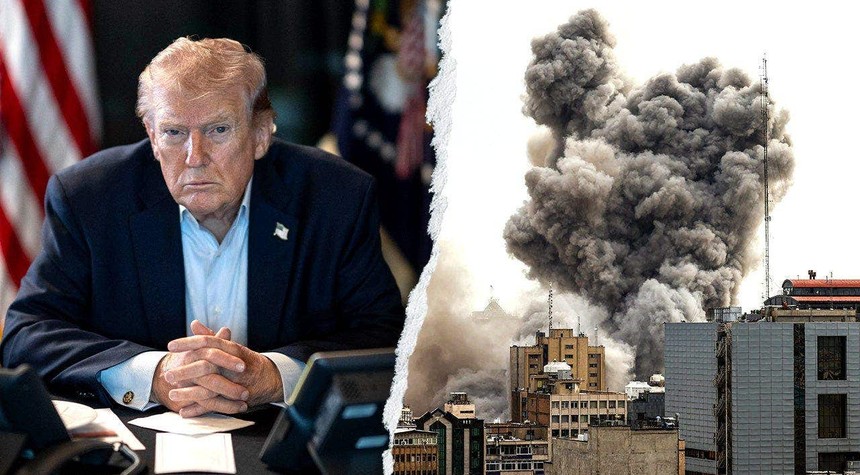
President Donald Trump announced Tuesday that American military operations against Iranian targets will continue indefinitely until Tehran agrees to enter serious negotiations, expressing deep frustration with what he characterized as Iran’s pattern of breaking international agreements.
In an interview with White House correspondents, the President outlined an intensifying campaign of military strikes that has already seen several consecutive days of operations near the strategically vital Strait of Hormuz. The President made clear his intention to maintain and escalate this pressure.
“We’re going to hit them very hard tonight,” Trump stated. “We’re going hit them hard tomorrow night. We’re gonna hit them really hard the night after.”
The President indicated that operations will continue until he personally determines that sufficient pressure has been applied to bring Iranian leadership to the negotiating table. This represents a significant escalation in American military posture toward the Islamic Republic, which controls one of the world’s most critical maritime chokepoints for global energy supplies.
U.S. Central Command has confirmed multiple strikes in the region over recent days. According to military sources, American forces have successfully targeted Iranian naval infrastructure, including a submarine and ship maintenance facility in Bandar Abbas. These operations have employed precision-guided munitions and unmanned aerial systems to minimize collateral damage while degrading Iranian military capabilities.
The President’s comments reflect growing impatience within the administration regarding Iran’s nuclear program and regional activities. Trump expressed particular concern about Tehran’s reliability as a negotiating partner, suggesting that previous diplomatic efforts have been undermined by Iranian unwillingness to honor commitments.
The Strait of Hormuz serves as a transit point for approximately one-fifth of the world’s petroleum supply, making it among the most strategically significant waterways on Earth. Iranian threats to close or disrupt traffic through the strait have long been a source of international concern, and Tehran’s military presence in the region represents a persistent challenge to freedom of navigation.
This latest escalation comes amid broader tensions between Washington and Tehran that have characterized much of the past two decades. The Iranian regime’s support for proxy forces throughout the Middle East, its nuclear ambitions, and its detention of American citizens have all contributed to deteriorating relations between the two nations.
The administration’s strategy appears designed to impose sufficient costs on Iran’s military infrastructure to compel a change in behavior without triggering a broader regional conflict. Whether this calibrated approach will succeed in bringing Iran to negotiations remains uncertain, as does the question of how long the American public will support sustained military operations in the Middle East.
International observers will be watching closely to see whether Iran responds with restraint or escalation, and whether America’s allies in the region and Europe support this more aggressive posture. The coming days will prove critical in determining whether Trump’s strategy achieves its stated objective of forcing serious negotiations, or whether it leads to a wider confrontation that neither side appears to want but both may find difficult to avoid.
Related: American Marine Biologist Murdered During Home Invasion in Philippines