
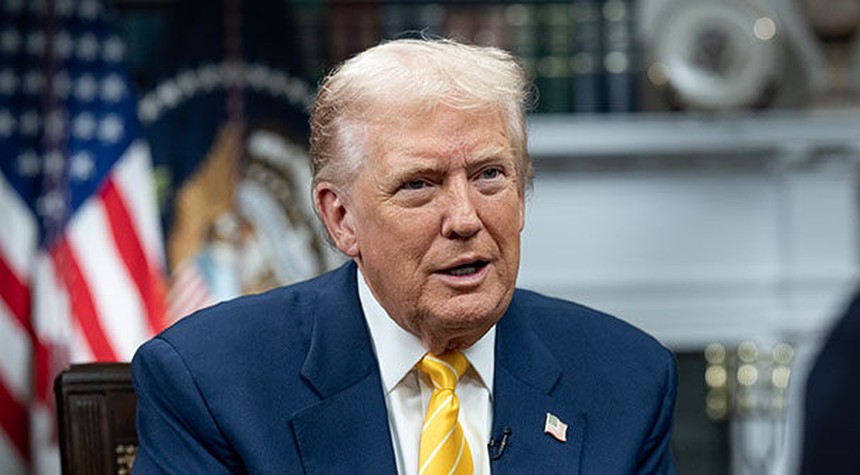
WASHINGTON — President Donald Trump provided an assessment of ongoing Russia-Ukraine peace negotiations Monday, expressing cautious optimism following extensive consultations with European leadership.
Speaking from the Oval Office before a Mexican Border Defense Medal presentation, the president outlined recent diplomatic efforts aimed at bringing the nearly four-year conflict to a conclusion.
“We had a very good conversation one hour ago with the European leaders, many of them, involving the war with Russia and Ukraine,” Trump stated. “We had a long discussion, and things are seemingly going well, but we’ve been saying that for a long time, and it’s a difficult one.”
The president’s consultations included conversations with Ukrainian President Volodymyr Zelensky and the leaders of Germany, Italy, France, the United Kingdom, Poland, Norway, Denmark, the Netherlands, Finland, and NATO leadership. Trump characterized these discussions as productive, noting positive developments in security protocols between the warring nations.
The president maintained his position that the conflict, which he referred to as “Biden’s situation,” should never have commenced. However, he expressed belief that resolution now appears more achievable than at any point since hostilities began.
“I think we’re closer now, and they will tell you that they’re closer now,” Trump said. “We had numerous conversations with President Putin of Russia, and I think we’re closer now than we have been ever, and we’ll see what we can do.”
The human cost of the conflict remains central to the administration’s urgency. Trump cited casualty figures ranging from 25,000 to 30,000 soldiers and civilians, describing the death toll as unprecedented since World War II. The president emphasized that American involvement centers on equipment sales to NATO rather than direct expenditure, while prioritizing the preservation of human life.
A significant challenge in the negotiation process, according to Trump, lies in maintaining consistent commitment from both parties. “At this moment, Russia wants to get it ended. The problem is they’ll want to get it ended, and then all of a sudden they won’t, and Ukraine will want to get it ended, and all of a sudden they won’t,” he explained. “So we have to get them on the same page, but I think that’s working along.”
Should the administration succeed in brokering peace between Russia and Ukraine, it would represent the ninth conflict resolution since Trump returned to office. The president has already facilitated the conclusion of hostilities in several regional disputes, including the historic Middle East peace agreement, conflicts between Israel and Iran, Azerbaijan and Armenia, the Democratic Republic of the Congo and Rwanda, Egypt and Ethiopia, Pakistan and India, and Cambodia and Thailand.
The administration recently addressed a renewed dispute between Cambodia and Thailand, and according to Turkish media reports, prevented potential escalation between Serbia and Kosovo.
The complexity of achieving lasting peace in Eastern Europe cannot be understated. The conflict has reshaped European security architecture and tested Western unity. Whether the current diplomatic momentum can overcome entrenched positions and produce a sustainable settlement remains the critical question facing international diplomacy today.
Related: China’s Massive Missile Arsenal Threatens American Bases Across Pacific Theater