
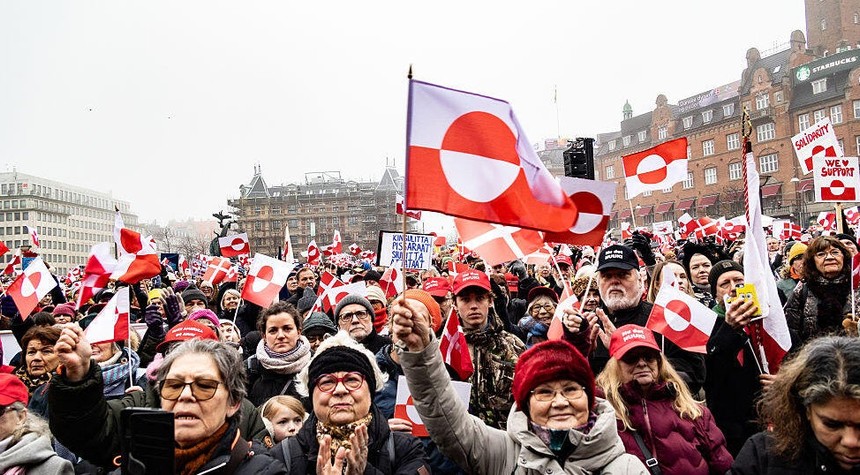
The transatlantic alliance faces one of its most serious tests in decades as President Trump announced Saturday that eight European nations will face a 10 percent tariff in response to their opposition to American interests in Greenland. The decision marks an extraordinary moment in Western relations, one that carries implications far beyond the Arctic Circle.
Denmark, Norway, Sweden, France, Germany, the United Kingdom, the Netherlands, and Finland now find themselves subject to these economic measures. The President’s announcement came as thousands of Greenlanders concluded demonstrations outside the U.S. Consulate in Nuuk, the territory’s capital, and as several European militaries deployed forces to Greenland under the banner of Arctic security training.
The facts of the matter are straightforward. Greenland, a semiautonomous territory under Danish sovereignty, occupies a position of undeniable strategic importance. The island’s location astride key Arctic shipping routes and its proximity to North America have long made it a subject of American security interest. President Trump has made clear his view that Greenland represents critical territory for U.S. national security in an era of renewed great power competition.
The eight affected nations responded with a joint statement Sunday, emphasizing their commitment to NATO and Arctic security. They described their military exercise, dubbed “Arctic Endurance,” as a pre-coordinated Danish operation that poses no threat. The statement expressed solidarity with Denmark and the people of Greenland while warning that tariff threats “undermine transatlantic relations and risk a dangerous downward spiral.”
Significant questions remain about implementation. The European Union functions as a single economic zone for trade purposes, complicating any attempt to target individual member states. Norway and the United Kingdom, not being EU members, present separate considerations. EU envoys convened emergency discussions Sunday evening to formulate a coordinated response.
The legal mechanism by which the President might impose these tariffs also requires examination. Emergency economic powers appear to be the most likely avenue, though such authority currently faces challenge before the Supreme Court.
European Union foreign policy chief Kaja Kallas warned that China and Russia stand to benefit most from any rift between America and Europe. She suggested that security concerns regarding Greenland could be addressed through existing NATO frameworks rather than through economic coercion.
The domestic political response has been predictably divided along partisan lines. Senator Mark Kelly of Arizona, a Democrat and former naval aviator, criticized the threatened tariffs as a measure that would force Americans to “pay more to try to get territory we don’t need.”
What remains clear is that this dispute represents more than a disagreement over an Arctic island. It tests fundamental questions about alliance relationships, sovereignty, and how the United States engages with partners who are also, in many respects, competitors in an increasingly multipolar world.
The coming days will reveal whether diplomatic channels can resolve these tensions or whether the President’s tariff announcement marks the beginning of a more fundamental realignment in Western relations. For now, the world watches as two pillars of the postwar order—American leadership and European unity—face a test neither may have anticipated.
Related: Death Toll Reaches Over 3,000 as Iran Claims Victory Over Street Demonstrations