
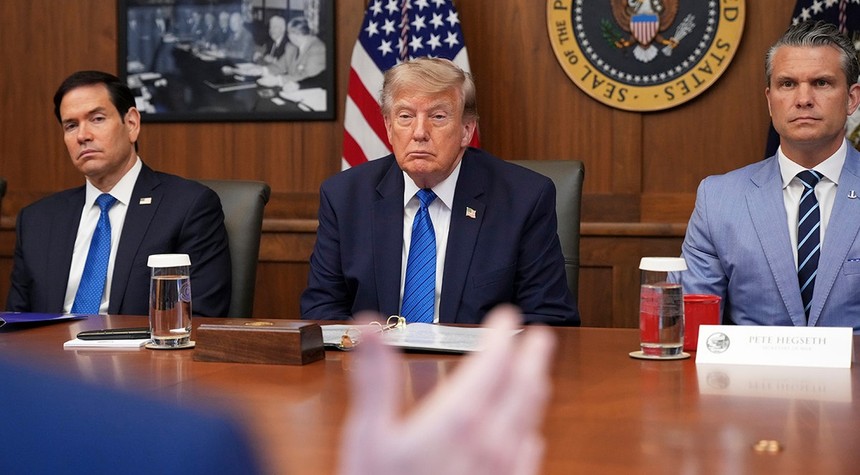
President Donald Trump delivered stark warnings about immigration policy during a Cabinet meeting at Camp David on Friday, drawing parallels between recent events in Spain and what he described as potential consequences should current border policies change.
The President referenced scenes from Spain’s North African enclave of Ceuta, where thousands of migrants crossed from Morocco in recent days. Trump characterized the situation as catastrophic and suggested similar or worse circumstances could develop along America’s southern border under different political leadership.
“I watched the catastrophe that took place,” Trump stated during the meeting, which included Secretary of State Marco Rubio and Secretary of War Pete Hegseth. “It looks like an invasion of a country by hundreds of thousands of people.”
The President connected the Spanish situation directly to American political considerations, arguing that maintaining current border security measures depends on electoral outcomes. He emphasized that despite construction of significant border barriers, which he noted fulfilled campaign promises, the security infrastructure alone would prove insufficient without proper enforcement policies.
Trump described what he characterized as Spain’s predicament as resulting from permissive legislation. “That is weak law, bad management, but very liberal law,” he said, suggesting that migrants in other countries monitor policy changes and respond accordingly. He claimed that people crossed into Ceuta through various means after perceiving opportunities created by recent Spanish legal modifications.
The comparison served a broader argument about American immigration policy. The President contended that the current administration inherited challenges from previous policies, specifically citing what he claimed were 25 million entries during the Biden administration. Trump asserted that significant portions of those who entered included individuals with criminal backgrounds.
“Many of those people are criminals. They’re murderers,” Trump said, adding that his administration had removed substantial numbers but that the initial entries represented fundamental policy failures.
The Spanish government faces mounting pressure as migrants continue arriving in Ceuta. The enclave, a Spanish territory on Morocco’s Mediterranean coast, represents one of the European Union’s only land borders with Africa, making it a focal point for migration attempts. Recent surges have strained local resources and prompted emergency responses.
Trump positioned the Spanish events as illustrative of broader patterns in Western nations grappling with migration pressures. His remarks suggested that American border security, while strengthened through infrastructure improvements, remains vulnerable to policy shifts that could encourage increased attempts at illegal entry.
The President’s comments at Camp David underscored themes that have remained central to his political messaging. Border security and immigration enforcement continue to feature prominently in his administration’s priorities and public communications.
The situation in Ceuta continues to develop, with Spanish authorities working to manage the influx while addressing the diplomatic dimensions involving Morocco. For Trump, the events provided a real-time example supporting his arguments about the consequences of what he characterizes as insufficient border enforcement.
As political attention turns toward future electoral contests, Trump made clear his intention to emphasize immigration policy as a defining issue, using international examples to illustrate his position that current American approaches represent necessary safeguards against scenarios unfolding elsewhere.
Related: Hamas Agrees to Weapons Decommissioning Under Trump Peace Framework