
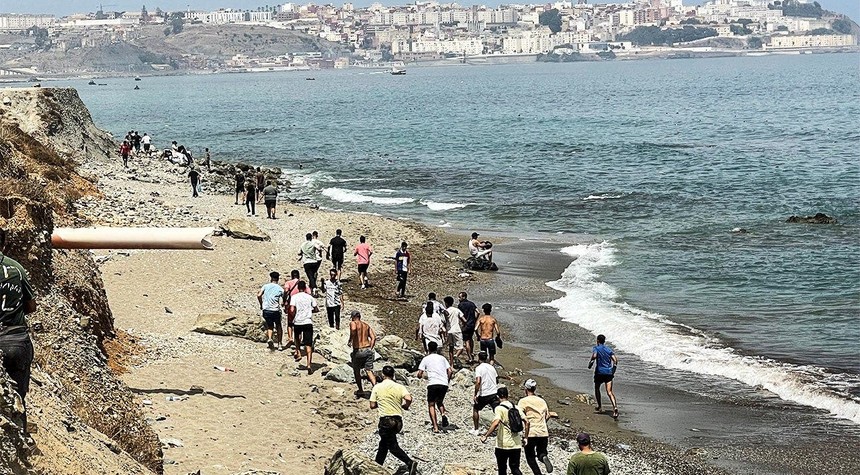
The United States State Department has elevated its travel advisory for the Spanish enclave of Ceuta to Level 3, urging Americans to reconsider travel to the North African territory following an unprecedented surge of migrants from Morocco that has prompted a significant military response.
The advisory, issued Saturday, warns that the “massive and uncontrolled arrival of migrants from Morocco to Ceuta may lead to unpredictable and dangerous security situations.” Spain has deployed its military forces, National Police, and Guardia Civil to manage what officials describe as a serious security crisis.
Ceuta, an autonomous Spanish city situated on the northern coast of Africa bordering Morocco, has been overwhelmed by an extraordinary influx of migrants this week. Spanish officials report that between 50,000 and 60,000 individuals crossed into the enclave over a 24-hour period beginning Thursday. While authorities indicate that thousands have since returned to Morocco, the situation remains volatile.
The advisory applies exclusively to Ceuta. The remainder of Spain continues under its existing travel advisory level, with no changes to guidance for the Spanish mainland or other territories.
Assistant Secretary of State Dylan Johnson characterized the events as a “mass invasion of tens of thousands of illegal migrants” and attributed the crisis to what he termed the Spanish government’s failure to adequately secure its borders. Johnson emphasized that the situation now poses broader implications for European security.
“The United States stands with the Spanish people and all European peoples in defense of their sovereignty,” Johnson stated. He added that the United States supports collaborative efforts by Spain, Morocco, and European partners to restore border control, prevent further loss of life, and address the presence of those who have entered illegally.
The crisis has placed enormous strain on local resources and infrastructure in Ceuta. President of the enclave, Juan Jesús Vivas, reported Friday that approximately 60,000 migrants had entered during the peak 24-hour period, though Spain’s Interior Ministry later adjusted that estimate to roughly 50,000 arrivals since Thursday.
Spanish authorities have mobilized a comprehensive response involving multiple security agencies. The deployment represents one of the most significant border security operations in recent Spanish history and underscores the magnitude of the challenge facing officials in Ceuta.
The situation has drawn international attention to the ongoing pressures facing European borders, particularly in territories that serve as geographic gateways between Africa and Europe. Ceuta, along with its sister enclave Melilla, has long been a focal point for migration attempts, but the scale of this week’s surge represents an extraordinary escalation.
The State Department’s advisory recommends that American citizens reconsider travel plans to Ceuta given the risks to personal safety and security. Americans currently in the area are advised to exercise increased caution and remain aware of their surroundings.
As this situation continues to develop, the international community watches closely to see how Spanish and Moroccan authorities manage both the immediate humanitarian concerns and the longer-term security implications of this crisis.
Related: White House Backtracks on Ukrainian Defense Manufacturing Agreement