
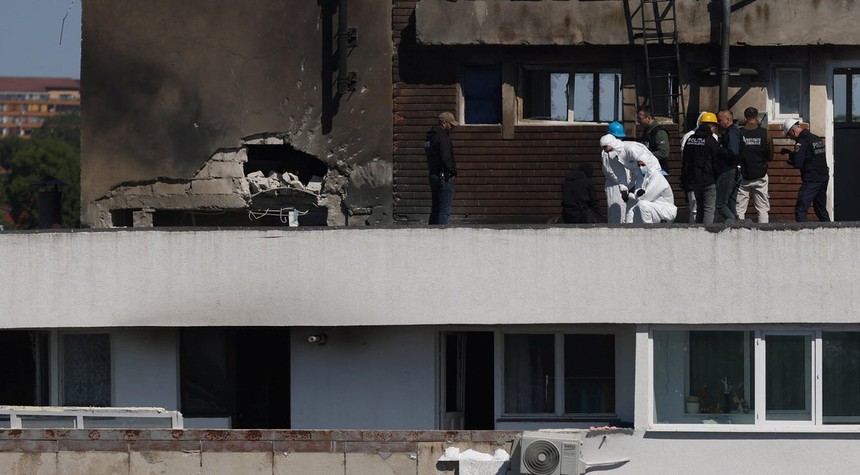
A Russian drone struck an apartment building in Romania early Friday morning, marking a significant escalation in a conflict that has now directly touched NATO territory. Two people sustained injuries in the attack on the alliance member nation.
The Romanian Defense Ministry confirmed that the incident occurred during the night of May 28-29, as Russian forces renewed their drone offensive against Ukrainian civilian and infrastructure targets near the river border shared by the two nations. One drone crossed into Romanian airspace, where it was tracked by radar systems to the southern section of Galati before crashing into the roof of a residential building. The impact ignited a fire that local emergency services subsequently extinguished. Two individuals received medical treatment for abrasions.
Romanian air defenses responded swiftly to the incursion. The Defense Ministry deployed two F-16 fighter jets after radar systems detected the unauthorized drones entering the nation’s airspace. This rapid response underscores the heightened state of alert along NATO’s eastern flank since the conflict in Ukraine began.
The incident represents more than an isolated accident. Romanian authorities have detected drone incursions dozens of times since Russia launched its full-scale invasion of Ukraine. Each violation of Romanian airspace constitutes a breach of NATO territory, carrying implications that extend far beyond the immediate damage inflicted.
NATO issued a firm response to the attack, characterizing Russia’s actions as reckless and reaffirming the alliance’s fundamental commitment to collective defense. The organization pledged to “defend every inch of Allied territory,” invoking the principle that has underpinned European security for more than seven decades.
Romania’s president announced plans to strengthen domestic air defense capabilities and confirmed that alliance partners would transfer additional equipment to Romanian forces. However, he provided neither specifics about the nature of this equipment nor a timeline for its delivery. This measured disclosure likely reflects operational security concerns while signaling to Moscow that NATO takes these violations seriously.
The Kremlin’s response proved characteristically minimal. State media reported that spokesman Dmitry Peskov confirmed President Vladimir Putin had been informed of the incident but offered no further comment. This silence leaves open questions about whether the drone strike resulted from deliberate targeting, navigational error, or simple disregard for the boundaries of NATO territory.
The attack on Romanian soil tests the alliance’s resolve at a critical juncture. While Article 5 of the NATO treaty commits all members to collective defense if one is attacked, the threshold for invoking this provision in response to what might be characterized as an errant drone remains unclear. Alliance leaders must now calibrate their response to demonstrate strength without precipitating a broader conflict.
For Romania and its NATO partners, the incident serves as a stark reminder that the war in Ukraine carries risks that extend beyond Ukrainian borders. As Russian forces continue their offensive operations with apparent disregard for the sovereignty of neighboring nations, the alliance faces mounting pressure to reinforce its eastern defenses while maintaining the delicate balance between deterrence and escalation.
Related: United States Moves Against Iranian Control of Strategic Waterway