
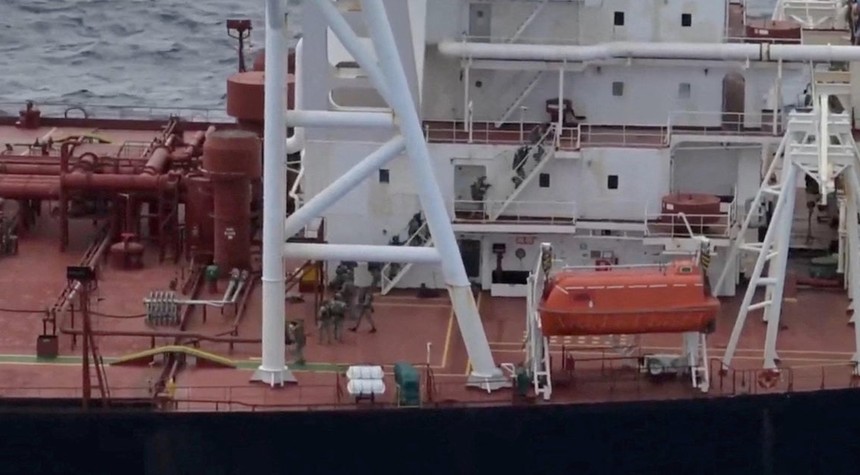
The United States military has intercepted and boarded a sanctioned oil tanker in the Indian Ocean after tracking the vessel across thousands of miles of open water, marking another enforcement action in the ongoing effort to dismantle Venezuela’s illicit petroleum trade.
The Defense Department announced Sunday that American forces successfully boarded the Veronica III without incident, conducting what officials termed a right-of-visit, maritime interdiction and boarding operation. The vessel had been under surveillance since departing Venezuelan waters in January, attempting to evade the quarantine on sanctioned tankers ordered by President Trump last December.
“The vessel tried to defy President Trump’s quarantine, hoping to slip away,” the Pentagon stated. “We tracked it from the Caribbean to the Indian Ocean, closed the distance, and shut it down.”
This operation demonstrates the reach and determination of American military capabilities in enforcing economic sanctions, even against vessels operating in distant waters under foreign flags. The Veronica III sailed under Panamanian registry, though the Panama Maritime Authority confirmed Sunday that the ship’s registration had been canceled in December.
The broader context of this interdiction relates directly to Venezuela’s systematic evasion of American oil sanctions through what intelligence officials have long identified as a shadow fleet of tankers. These vessels, often operating under false flags and with obscured ownership, have enabled the Maduro regime to continue exporting crude oil despite years of American economic pressure designed to isolate the socialist government.
The quarantine order issued in December represented an escalation in enforcement efforts, coming just weeks before American military forces apprehended Nicolás Maduro himself in January during a dramatic operation that fundamentally altered the political landscape in Caracas. That raid prompted an exodus of tankers from Venezuelan ports, with several vessels attempting to reach international waters before American forces could establish control.
The Veronica III appears to have been among those ships that fled in the immediate aftermath of Maduro’s capture. However, the vessel’s attempt to disappear into the vastness of the Indian Ocean proved unsuccessful against American tracking capabilities and the willingness to pursue targets across hemispheres.
According to Treasury Department records, the Veronica III carries sanctions related to Iran, suggesting the vessel may have been involved in multiple sanctions evasion schemes beyond its Venezuelan activities. This dual-purpose use of shadow fleet tankers has become increasingly common as sanctioned regimes share resources and expertise in circumventing international restrictions.
The Pentagon released video footage of the boarding operation, showing American forces approaching and securing the tanker in what appeared to be calm seas. The operation’s success without incident speaks to both the professionalism of American forces and the futility of resistance when confronted by overwhelming military superiority.
This interdiction sends an unmistakable message to other vessels currently attempting to transport sanctioned oil: distance provides no sanctuary from American enforcement actions. The ability to track a single tanker from Caribbean waters through the Panama Canal region and across the Pacific to the Indian Ocean demonstrates surveillance capabilities that leave few hiding places for sanctions violators.
The fate of the Veronica III and its cargo remains under determination by American authorities.
Related: Hong Kong University Expels Student Who Sought Investigation Into Deadly Apartment Fire