
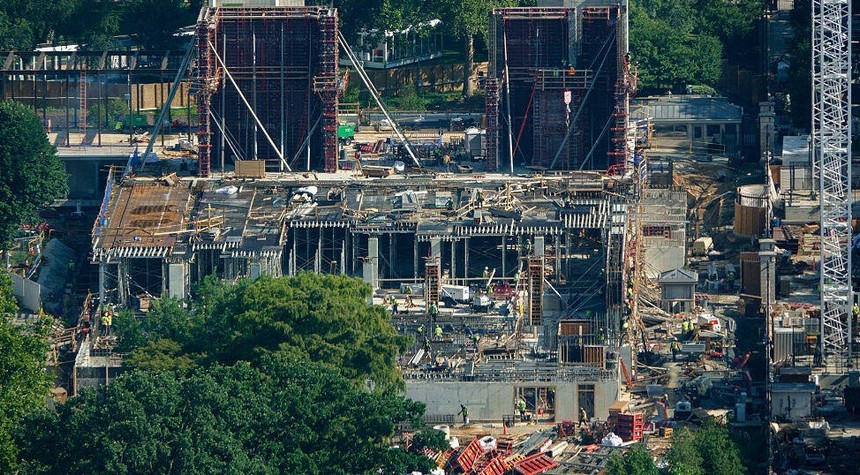
A federal appeals court delivered a significant ruling Friday that strikes at the heart of executive authority over federal property, determining that President Trump cannot proceed with his planned $400 million ballroom construction at the White House without explicit congressional authorization.
The decision from the U.S. Court of Appeals for the District of Columbia Circuit marks a critical moment in the ongoing debate over presidential power and the constitutional separation of powers. At issue is a proposed 90,000-square-foot ballroom that would replace the existing East Wing, a project the administration has sought to fund through privately collected donations.
In a 2-1 decision, the appellate panel upheld a lower court ruling that found the White House “very likely” lacks the authority to demolish and reconstruct substantial portions of the executive mansion without congressional consent. The majority opinion articulated a principle that may surprise those unfamiliar with the constitutional framework governing federal property.
“Each President is a temporary tenant, not the owner, of the White House and its Executive Residence,” the judges wrote. “The President has no—and claims no—constitutionally assigned authority over that property, which is designed and maintained for the use of all Presidents, current and future, and for the American people.”
The court emphasized that Congress maintains “full constitutional control over federal property and the funding of its maintenance and development.” This authority extends even to privately funded projects that would fundamentally alter structures built and maintained at taxpayer expense.
The majority opinion, authored by Judges Patricia Millett and Bradley Garcia, noted the unprecedented nature of the administration’s approach. “We are aware of no instance in American history in which a President unilaterally and using privately collected funds demolished substantial portions of the White House that Congress authorized to be built and American taxpayers paid for,” they observed. “Until now.”
Judge Neomi Rao dissented from the majority, arguing that the National Trust for Historic Preservation, which brought the initial lawsuit, lacked proper legal standing. She characterized both the lower court’s decision and her colleagues’ ruling as “judicial overreach.”
The political composition of the panel has not gone unnoticed. Millett received her appointment from President Obama, Garcia from President Biden, and Rao from President Trump himself.
President Trump responded swiftly and forcefully to the decision, announcing immediate plans to appeal to the Supreme Court. He characterized the ruling as “horrendous, politically motivated, and unlawful,” calling for the high court to overturn it “in its entirety.”
The appeals court stayed its decision for fourteen days, providing the administration time to seek Supreme Court intervention. This procedural grace period ensures the matter can proceed to the nation’s highest court without delay.
The majority took care to clarify the limited scope of their ruling. “This holding has nothing at all to do with whether the proposed ballroom is desirable, or not, as a matter of policy,” they wrote. “This ruling does not even necessarily mean that the Defendants may not ultimately construct the ballroom. What it does mean is that the Defendants may not do so during the district court’s expeditious litigation without securing Congress’s authorization, as the Constitution and laws require.”
The case now heads toward what promises to be a consequential Supreme Court showdown over executive authority, congressional power, and the unique constitutional status of America’s most famous residence.
Related: Senate Passes Sweeping Russia Sanctions Bill After Year of Delays