
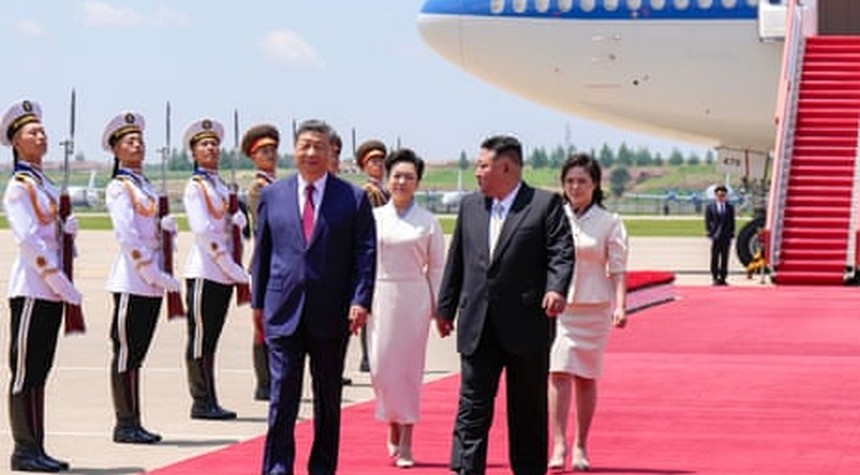
Chinese President Xi Jinping touched down in Pyongyang Thursday for his first visit to North Korea in nearly seven years, marking a significant diplomatic effort by Beijing to reassert its influence over an ally that has grown increasingly close to Moscow.
The two-day state visit comes at a critical juncture in Northeast Asian geopolitics, as China watches with evident concern while North Korea deepens its military and economic ties with Russia. The elaborate welcome ceremony underscored both the historical significance of the Sino-North Korean relationship and Beijing’s determination to remain the dominant external influence in Pyongyang.
State media footage showed Xi and his wife, Peng Liyuan, arriving at Sunan International Airport aboard an Air China aircraft. The Chinese delegation, which included Foreign Minister Wang Yi and Cai Qi, Xi’s chief of staff, was greeted by a red carpet flanked by North Korean honor guards in full ceremonial dress.
The formalities continued at Kim Il-sung Square in central Pyongyang, where Kim Jong-un and his wife, Ri Sol-ju, personally welcomed the Chinese leader. The ceremony featured all the trappings of a major state visit: a military band performed both nations’ anthems, a twenty-one-gun salute echoed across the capital, and children presented flowers to the visiting dignitaries.
Large crowds assembled for the occasion carried flags, flowers, and balloons beneath banners proclaiming “We warmly welcome Comrade Xi Jinping” and celebrating the “unbreakable friendship” between the two communist nations. Following the public ceremony, Kim and Ri escorted their guests to the Kumsusan guesthouse, a luxurious state-owned compound that serves as accommodations for visiting heads of state.
The visit represents a recalibration of regional dynamics that have shifted considerably since Xi’s last trip to North Korea. In recent months, Pyongyang has supplied substantial quantities of artillery shells and missiles to support Russia’s military operations in Ukraine, while Moscow has provided North Korea with economic assistance and technological cooperation that has alarmed both Washington and its regional allies.
For Beijing, this growing Russia-North Korea partnership presents both strategic and diplomatic complications. China has long viewed North Korea as a buffer state and a critical element in its regional security architecture. Any diminishment of Chinese influence in Pyongyang could alter the balance of power in Northeast Asia and potentially complicate Beijing’s broader geopolitical objectives.
The timing of Xi’s visit also reflects China’s broader concerns about stability on the Korean Peninsula. While Beijing has historically served as North Korea’s primary economic lifeline and diplomatic protector, that relationship has been tested by Pyongyang’s nuclear weapons development and its recent pivot toward Moscow.
This state visit signals Beijing’s intention to remind both Pyongyang and the international community that the Sino-North Korean alliance, forged in the Korean War and sustained through decades of ideological solidarity, remains a cornerstone of regional politics. Whether Xi can successfully draw Kim Jong-un back into China’s orbit, however, remains an open question that will have significant implications for the future of Northeast Asian security.
Related: Israeli Military Strikes Iran Following Missile Exchange as Trump Urges Restraint