
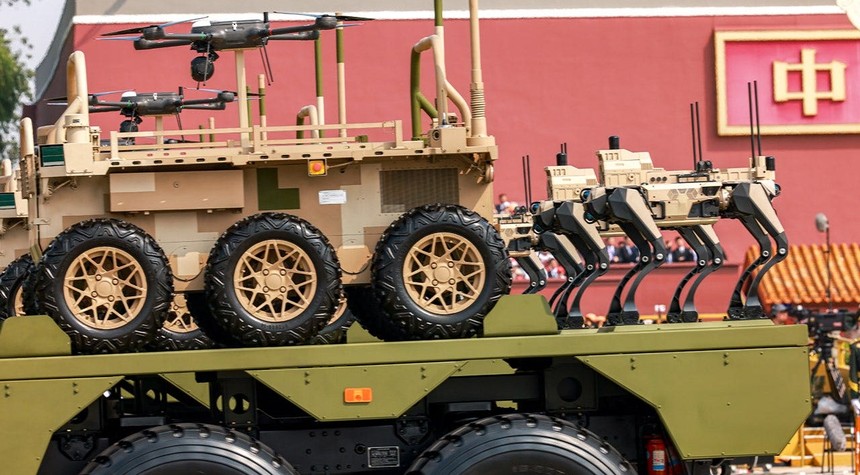
The People’s Liberation Army is developing coordinated units of AI-enabled robotic systems designed to scout terrain, transport supplies, and potentially engage in combat operations during a future conflict, including a possible invasion of Taiwan. This development represents a fundamental shift in how modern warfare may be conducted.
According to a recent analysis from the Foundation for Defense of Democracies, Beijing has moved beyond mere demonstrations of robotic technology and is now integrating these systems into operational military units. At the heart of this effort are quadruped robots, commonly referred to in Chinese military reporting as “robotic wolves,” which form the basis of what Chinese strategists call “intelligentized warfare.”
These are not the robotic novelties China has displayed at technology exhibitions in recent years. The analysis indicates that the People’s Liberation Army is testing these systems as coordinated battlefield units capable of operating at scale, particularly in high-risk scenarios such as the initial phases of an amphibious assault on Taiwan.
The strategic implications are considerable. A military force built around expendable, networked machines could enable Chinese commanders to sustain offensive operations while significantly reducing personnel casualties. This capability would potentially lower both the political and military costs of armed conflict for Beijing, a calculation that matters greatly when considering operations against Taiwan.
The Foundation for Defense of Democracies assessment states plainly that China is not merely modernizing its military forces but fundamentally reimagining how future wars will be fought.
In testing exercises documented by Chinese sources, these robotic systems perform primarily reconnaissance and logistical support functions. They move ahead of advancing troops to map terrain, identify threats, and transport supplies through hazardous areas. The quadruped robots can navigate challenging terrain, including stairs and debris-filled urban environments, and operate in coordinated groups to extend a unit’s operational reach.
Some Chinese military reporting depicts armed variants of these systems operating alongside troops and unmanned aerial vehicles during simulated assault operations, though many of these claimed capabilities remain unverified by independent observers.
The United States military is developing its own robotic and autonomous systems, though analysts note that China’s ability to leverage its commercial technology sector may provide advantages in scaling production rapidly. This represents a concerning development in the strategic competition between Washington and Beijing.
A potential conflict over Taiwan emerges as the most likely scenario for deploying these systems at scale. An amphibious invasion would require Chinese forces to operate in dense urban terrain, contested coastal zones, and communications-degraded environments. These are precisely the conditions where unmanned systems could be employed to clear routes, absorb initial combat losses, and maintain offensive momentum as troops advance inland.
The systems do face limitations, however. They rely on sophisticated communications networks and artificial intelligence systems that remain vulnerable to electronic warfare and jamming. Questions also remain about their effectiveness in actual combat conditions, as opposed to controlled testing environments.
What remains clear is that the nature of warfare continues to evolve, and nations that fail to adapt to these changes risk finding themselves at a severe disadvantage in future conflicts. The development of these robotic wolf packs represents more than technological advancement. It represents a strategic choice by Beijing about how it intends to project military power in the Pacific region.
And that is the way it is.
Related: White House Declares End to Iran Hostilities as Congressional Opposition Intensifies