
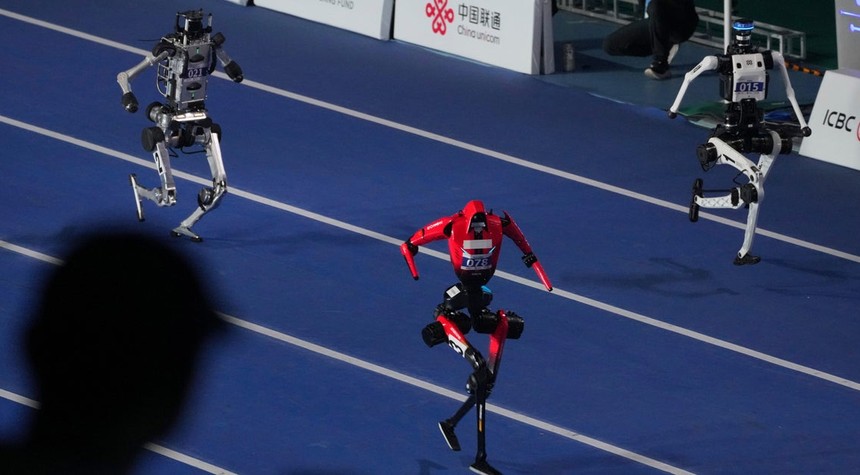
Chinese humanoid robots have achieved what was once considered impossible, surpassing long-standing human athletic records at the World Humanoid Robot Games held in Beijing this past Saturday. The demonstration represents the latest milestone in China’s aggressive push toward robotics supremacy, occurring just weeks after American authorities moved to restrict Chinese robotics imports on national security grounds.
A humanoid robot manufactured by Beijing-based X-Humanoid completed the 100-meter sprint in 9.39 seconds, eclipsing the 9.58-second record set by Jamaica’s Usain Bolt in 2009. The achievement, while remarkable from an engineering standpoint, came with limitations inherent to current robotics technology. Video footage from the event showed the machines unable to decelerate naturally, instead slamming into cushions and collapsing at the finish line before being removed on stretchers.
Another robot from the same manufacturer cleared 2.88 meters in the standing high jump, surpassing the human record of 2.45 meters established by Cuba’s Javier Sotomayor in 1993. These successes stood in stark contrast to other competitors, which experienced catastrophic failures including tripping, disintegration upon impact, and in some cases, catching fire during competition.
The World Humanoid Robot Games, now in its second year, features more than 2,000 humanoid robots competing in events ranging from running and high jumping to table tennis and soccer. The opening ceremony featured hundreds of humanoid robots marching in synchronized formation, a display clearly designed to showcase China’s organizational and technological capabilities to the world.
This demonstration of technological prowess arrives at a moment of heightened tension between Washington and Beijing over robotics technology. Last month, the Federal Communications Commission announced a ban on imports of new foreign-made humanoid robots, citing national security concerns in what was widely understood as a measure targeting China. The Pentagon has further escalated matters by adding Unitree, one of China’s premier humanoid robot manufacturers, to its list of companies deemed to have ties with the Chinese military. Beijing has rejected these accusations.
China currently dominates global humanoid robot production, with manufacturers reporting thousands of orders from both government agencies and private sector clients. This industrial capacity gives Beijing a significant advantage in a sector many experts believe will prove strategically important in the coming decades.
However, experts caution against overstating the immediate practical applications of this technology. While the athletic demonstrations make for impressive spectacles, these robots remain primarily suited for demonstrations and performances rather than real-world deployment. The path from controlled competition to mass commercial and industrial use will require substantial additional development, particularly in areas such as autonomous decision-making, energy efficiency, and durability.
The juxtaposition is striking: machines that can outrun the fastest human cannot yet safely stop themselves. That reality suggests that while China has made undeniable progress in robotics hardware, the technology remains in its developmental stages. The question facing policymakers in Washington and capitals worldwide is whether American security concerns and import restrictions will slow China’s progress or simply exclude American companies and researchers from participating in what may prove to be a transformative industry.
Related: New Space Policy Sets Goal of 1,000 Annual Launches as Pentagon Warns of Satellite Threats