
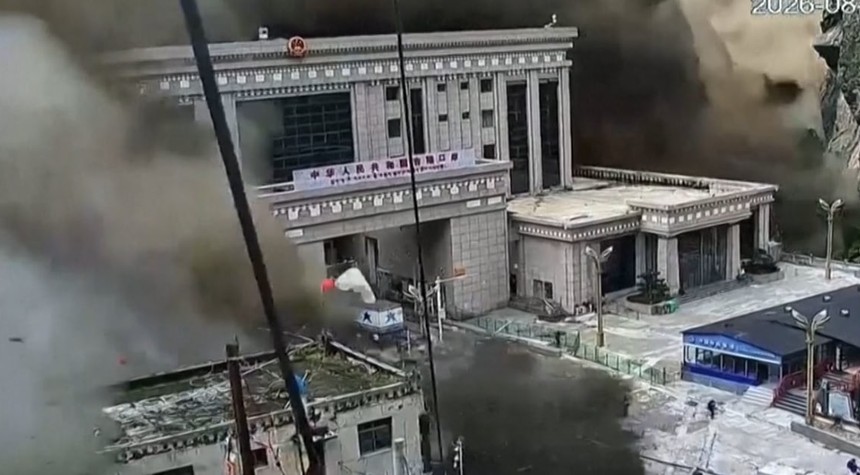
The images emerging from the Nepal-Tibet border tell a story of devastation that challenges comprehension. Surveillance footage from the Rasuwagadhi border crossing shows what survivors can only describe as a wall of mud and debris descending upon unsuspecting travelers with terrible swiftness. Buses and trucks, parked in orderly rows moments before, are tossed aside with contemptuous ease. Where there was life and movement, there remains only wreckage.
As of this evening, Nepali authorities confirm at least 157 dead, with hundreds more missing in the mountain regions north of Kathmandu. The true scale of human loss remains uncertain, as power and communication infrastructure has been swept away entirely in some areas. American citizens are among those affected, according to the State Department, which reports it is monitoring the situation closely.
The disaster struck Wednesday when what climate researchers believe was a glacier avalanche triggered catastrophic flash flooding through the Himalayan valleys. The Lhende Khola river, already swollen from seasonal conditions, became a torrent of destruction when ice and rock from a glacier collapsed, temporarily damming the waterway before releasing a surge downstream.
Verified footage shows the transformation of peaceful green valleys into churning channels of destruction within moments. Bridges that had stood for decades were cracked apart and carried away. Roads vanished. Buildings were swept from their foundations. In one video captured aboard a bus in Bidur, passengers’ screams fill the air as they watch the wall of water approach in the distance, vehicles and pedestrians alike attempting desperate flight.
“There is devastation everywhere we look,” said Tula Bahadur BK, a health worker in the hardest-hit Rasuwa region. “The settlements next to the river have been completely swept away. Five of my own relatives are missing.”
The catastrophe has prompted emergency declarations in both Nepal and Chinese-administered Tibet, where casualty figures remain equally uncertain. Hundreds of tourists, drawn to these popular trekking regions, are among the missing. Both nations have deployed rescue teams, and Nepal has requested assistance from India and China.
Satellite imagery reveals the scope of the flooding’s impact. The Trishuli River basin, normally a modest waterway, swelled dramatically with mud and debris, transforming the landscape.
A magnitude-4.4 earthquake, recorded by the United States Geological Survey approximately sixty miles north of Kathmandu early Wednesday, may have contributed to the glacier’s instability, though investigators are still working to establish a definitive sequence of events.
Climate researchers at the Kathmandu-based International Centre for Integrated Mountain Development note that this marks the second time in fourteen months that the Lhende Khola has experienced major flooding. The pattern, they warn, reflects broader changes in the Himalayan region, which scientific data shows is warming at a rate faster than the global average due to human-caused climate change.
Saswata Sanyal, a disaster risk reduction specialist with the research group, emphasized the critical importance of early warning systems “in a warming Himalaya.” The region, spanning multiple nations including India, faces particular vulnerability to floods and landslides as rising temperatures alter the stability of ancient glaciers and increase the intensity of seasonal rains.
As rescue efforts continue, the question facing authorities is not merely how to respond to this disaster, but how to prepare for what climate data suggests may become an increasingly common threat to communities throughout the Himalayan range.
Related: United States Requests Ukrainian Strike Pause During High-Level Moscow Negotiations