
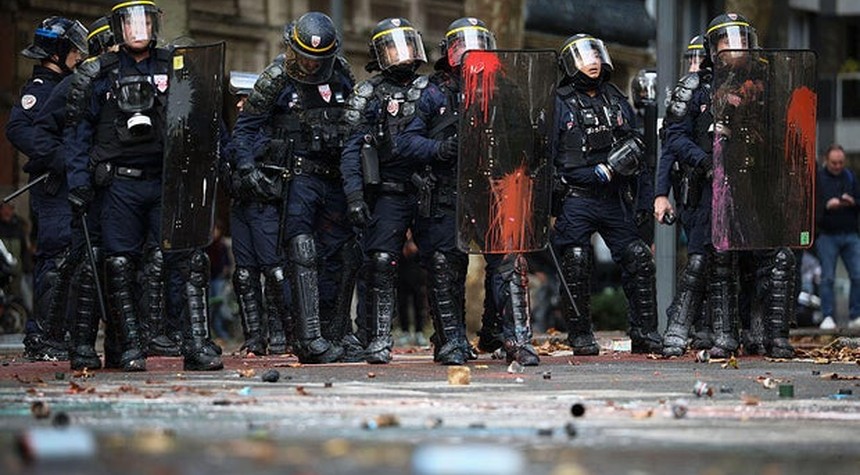
France witnessed scenes of civil disorder on Saturday not seen since the height of the yellow vest movement in 2018, with authorities detaining a record 855 individuals as protests against rising living costs descended into widespread violence across the nation.
The demonstrations, which began peacefully in multiple cities, deteriorated rapidly as masked agitators set vehicles ablaze, looted commercial establishments, and engaged in direct confrontations with law enforcement. In Paris, police deployed tear gas and water cannons to disperse violent elements who hurled fireworks, paving stones, and various projectiles at officers near the Place de la République.
The scale of the disturbances extended far beyond the capital. In Lyon, France’s third-largest city, approximately 20,000 protesters marched through the streets as a fire erupted inside a tourist office. The southwestern city of Limoges suffered particularly severe damage when masked protesters broke into the town hall and set it ablaze, causing the collapse of the 143-year-old building’s spire. Maurice Barate, the regional prefect, described the perpetrators as a “wild horde” that had “deliberately” destroyed the historic structure.
Interior Minister Laurent Nuñez’s office reported “a growing number of violent incidents” throughout the country, including direct assaults on police officers, systematic looting, and extensive damage to public buildings. Violence also erupted in Marseille, where demonstrators briefly breached City Hall’s lobby, prompting Mayor Benoît Payan to declare the actions “unacceptable.” Similar disturbances occurred in Rennes, Toulouse, Montpellier, and Grenoble.
The protests represent a resurgence of the yellow vest movement, which originally emerged in 2018 as a populist response to perceived social injustice and economic inequality. This time, demonstrators have mobilized through social media in response to sharply increased gasoline, energy, and food prices in recent months, expressing deep frustration with government policies they believe favor wealthy citizens while neglecting public services.
Not all participants engaged in violence. The majority of protesters joined peaceful marches, waving French flags, chanting the national anthem, and playing musical instruments as they proceeded through northwestern Paris. Many high school students participated alongside their parents, highlighting the broad demographic appeal of the movement.
One protester, Sonia Mabrouk, a 40-year-old who participated in the original yellow vest demonstrations, attended Saturday’s protest with her high school student daughter to voice opposition to “everything that’s going wrong,” particularly what she characterized as the systematic neglect of public services and policies favoring the wealthy.
The French government took extraordinary security measures, closing numerous metro stations at police request, including those near the Champs-Elysées, the presidential palace, parliament, and government offices. Despite these precautions, authorities struggled to prevent small groups of protesters from converging on government buildings throughout the day.
The record number of detentions underscores the severity of the situation facing French authorities as they confront renewed civil unrest amid deteriorating economic conditions. Whether this represents an isolated outburst or the beginning of sustained protest activity remains to be seen, but the parallels to 2018 are unmistakable and concerning for a government already facing mounting criticism over its economic policies.
Related: Pope Leo XIV Celebrates Mass at Rome Hospital Following Lung Cancer Surgery