
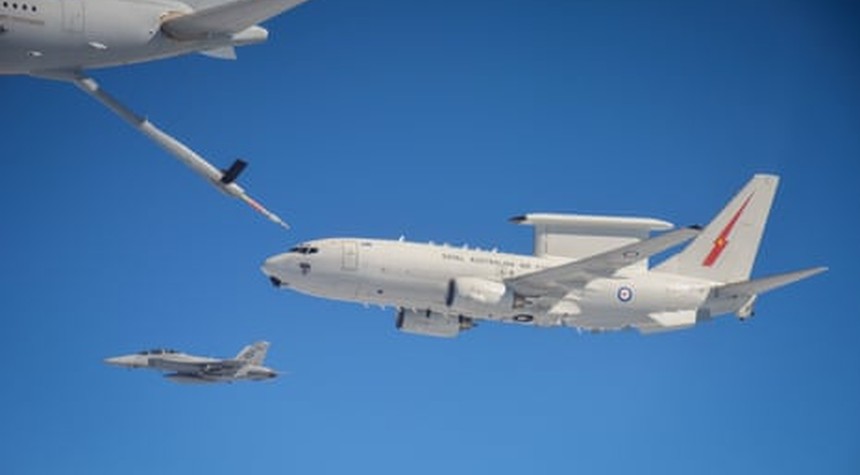
Australian military personnel operating an advanced surveillance aircraft in the Middle East are deliberately filtering intelligence to ensure information shared with the United States cannot be used for offensive military operations, according to the nation’s highest-ranking defense official.
Admiral David Johnston, Chief of Defence, confirmed Thursday that crews aboard the E-7 Wedgetail aircraft are taking what he described as “active steps” to contribute only to defensive operations in the region. The announcement came as Prime Minister Anthony Albanese’s government extended the deployment beyond its original four-week mission to the United Arab Emirates.
The arrangement represents a delicate balancing act for Australia, which finds itself supporting American operations while attempting to maintain strict parameters around its involvement in a conflict that has generated considerable controversy. The Labor government has faced pointed criticism for its association with military actions led by President Donald Trump and Israeli Prime Minister Benjamin Netanyahu.
According to Johnston, the sophisticated capabilities of the Wedgetail platform allow operators to exercise considerable discretion over what intelligence leaves the aircraft. Speaking from the Russell defence headquarters in Canberra, the admiral emphasized that this filtering capability was a fundamental consideration in how the aircraft was deployed.
“The capabilities of the aircraft are such that it is the operators of that platform who determine what information leaves the platform,” Johnston explained. The crews apply filters and make judgments about the nature of detected information, whether from radar systems or electronic surveillance, before determining what enters the broader air operation system.
The deployment involves approximately 85 Australian defence force members who were dispatched to the UAE in early March. While intelligence regarding drones and other airborne threats continues to flow to American forces, information that could facilitate offensive operations is being withheld by the highly trained Australian crews.
Prime Minister Albanese declined to specify the Wedgetail’s future operating locations, stating only that the aircraft would remain “in the region for a period of time” before departing for Singapore on Thursday.
The mission extension comes just days before Australia releases its next national defence strategy. Johnston characterized the E-7 Wedgetail as “a gem of an aircraft,” underscoring its value to Australian military capabilities.
When questioned about potential Australian involvement in efforts to reopen the Strait of Hormuz, Johnston acknowledged the Royal Australian Navy possesses the capability to operate in that environment but suggested such deployment might not align with Australia’s strategic priorities.
“I am very confident we could deploy a ship into that environment if the government was to make a decision to do so,” Johnston stated. However, he raised what he termed an equally important question regarding where Australia’s priorities should lie, noting that the United States has already moved substantial military capacity into the Gulf region, including forces drawn from the Indo-Pacific.
That final observation carries particular weight for Australia, a nation whose security interests remain firmly anchored in the Indo-Pacific theater. The implicit concern is that American military resources diverted to the Middle East may leave the Indo-Pacific region with reduced American presence at a time when Australia faces its own strategic challenges closer to home.
The filtering arrangement demonstrates both the sophistication of Australian military technology and the government’s attempt to thread a diplomatic needle, supporting an ally while maintaining boundaries around the nature of that support.
Related: Pakistani National Pleads Guilty to Planning ISIS-Inspired Attack on New York Jewish Center