
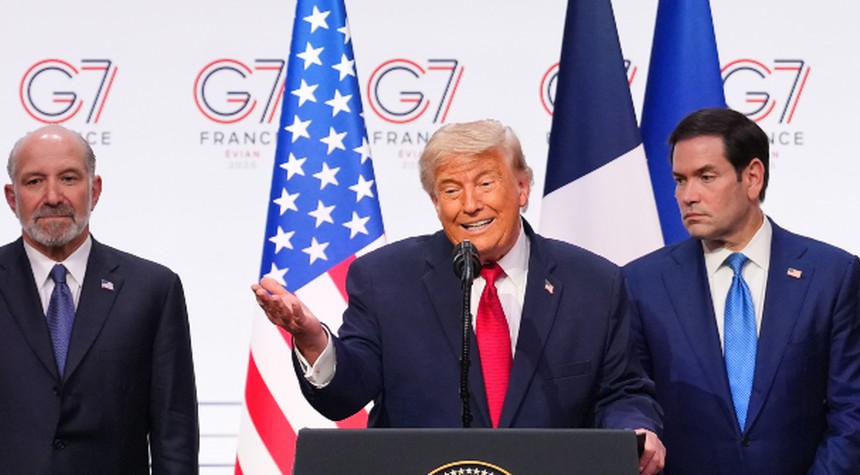
President Donald Trump arrived in Evian, France, for the Group of Seven summit with characteristic confidence, declaring himself “the boss” to assembled world leaders and journalists. The lighthearted moment drew laughter from the room, as did his invitation to reporters to remain for what would be closed-door negotiations. The press corps was, of course, required to depart once formal discussions commenced.
The levity masked what proved to be a substantive diplomatic achievement for the American president. By the summit’s conclusion, Trump had secured a joint statement of support from the G7 nations for his Iran peace agreement, a significant validation of his administration’s Middle East policy.
The joint statement welcomed what it termed “an historic opportunity” to prevent Iran from acquiring nuclear weapons while addressing threats posed by the Islamic Republic’s regional activities and ballistic missile program. The G7 leaders specifically praised Trump’s “strong leadership” in securing the deal with Iran, crediting the support of unnamed mediating countries in bringing the agreement to fruition.
Of particular strategic importance, the assembled leaders backed Trump’s insistence that Iran will not be permitted to impose “restrictions or tolls” on the Strait of Hormuz, the vital waterway through which roughly one-fifth of the world’s petroleum passes. This represents a firm line against any Iranian attempt to leverage control of this critical maritime chokepoint.
The G7 statement endorsed a multinational naval initiative led by France and the United Kingdom, designed to protect merchant vessels and restore confidence among commercial shipping operators. This defensive operation aims to facilitate the resumption of normal maritime traffic through the strait and ensure the removal of any mines that might threaten safe passage.
The leaders’ declaration included an unequivocal assertion that “Iran will never obtain a nuclear weapon,” pledging robust diplomatic support for American efforts to prevent such an outcome. This united front from America’s closest allies represents a diplomatic victory for Trump, who has made confronting Iranian ambitions a centerpiece of his foreign policy.
The Evian summit demonstrated that despite occasional friction over trade and defense spending, the G7 nations remain capable of presenting a unified position on matters of global security. The agreement on Iran policy suggests that European allies, while maintaining their own diplomatic channels with Tehran, recognize the necessity of supporting American leadership on this critical issue.
For Trump, the summit provided an opportunity to showcase his unconventional diplomatic style while achieving concrete results. His casual demeanor and confident assertions, which critics sometimes characterize as inappropriate for international diplomacy, appeared to work in this setting. The substantive agreement on Iran policy vindicated his approach and demonstrated that personal rapport and direct communication can yield tangible diplomatic achievements.
As the president departed France, he carried with him a document that strengthens his hand in future negotiations with Iran and reinforces American credibility in the volatile Middle East region. Whether this diplomatic success translates into lasting peace and stability remains to be seen, but for now, the G7 has spoken with one voice in support of the American position.
Related: Trump Sets 60-Day Deadline for Comprehensive Iran Deal at G7 Conclusion