
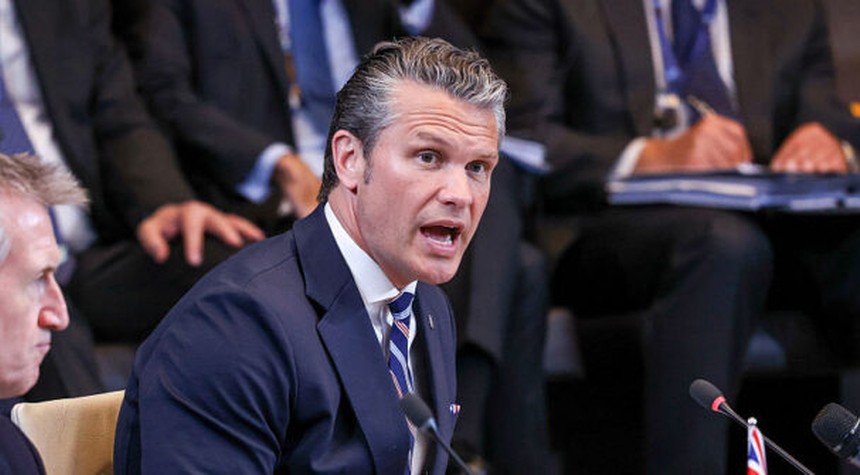
Defense Secretary Pete Hegseth delivered an unvarnished assessment of NATO’s deteriorating military capabilities to alliance defense ministers in Brussels on Thursday, warning European partners they have six months to demonstrate serious commitment to collective defense or face consequences for American participation.
Speaking at NATO headquarters, Hegseth opened the ministerial session with remarks he characterized beforehand as “candid,” telling reporters that “friends being honest with friends” was essential. His message was clear: the decades-long arrangement where European nations enjoyed American security guarantees while cutting their own defense spending has reached its end.
“President Trump has been very clear on this point over two administrations,” Hegseth told the assembled ministers. “For too long NATO has been a paper tiger and a one way street. No more.”
The Defense Secretary’s remarks centered on what alliance officials call “NATO 3.0,” a concept frequently invoked by Secretary General Mark Rutte to describe the transformation now required of member states. This represents a return to the alliance’s original Cold War posture, when European members maintained substantial military forces capable of genuine deterrence against Soviet aggression.
That first NATO stands in stark contrast to what Hegseth termed “NATO 2.0,” the post-Cold War era when European nations dramatically reduced defense spending to claim what they called a “peace dividend.” Those funds were redirected primarily toward expanding welfare programs, while military readiness atrophied across the continent.
Hegseth drew a direct connection between NATO’s military decline and broader European societal failures. The alliance, he noted, had become preoccupied with “gender equity and climate change” rather than warfighting capability. Meanwhile, European nations opened their borders to mass migration that critics describe as an invasion, while welfare states expanded to dominate national budgets.
“Defense budgets cratered, along with Europe’s belief in itself and its civilization,” Hegseth said. “NATO lost its way. NATO 2.0 was an era of distraction, deindustrialization, and demilitarization.”
The Defense Secretary invoked the postwar European leaders who founded the alliance, noting that Winston Churchill, Charles de Gaulle, and Konrad Adenauer never intended Europe to become a dependency of the United States. Those statesmen envisioned capable European powers contributing substantially to their own defense within a transatlantic framework.
The Trump administration’s position represents a fundamental shift in American expectations. The old arrangement, where minimal European military contribution was accepted as sufficient, “is not going to cut it any more,” Hegseth stated flatly.
The six-month timeline Hegseth established creates genuine pressure on European governments to demonstrate tangible progress. What specific consequences might follow remains unclear, though the implication that American commitment could be reassessed carries obvious weight.
This moment represents a critical juncture for the transatlantic alliance. For seventy-five years, NATO has served as the cornerstone of Western security architecture. Whether European nations possess the political will to rebuild military capabilities they spent decades dismantling will determine if that architecture endures in recognizable form.
The challenge facing European leaders is substantial. Reversing decades of defense cuts while managing existing welfare obligations and addressing the security consequences of open-border policies requires political courage increasingly rare in contemporary European governance. Whether Thursday’s warning from Brussels proves sufficient motivation remains to be seen.
And that is the situation as it stands this evening.
Related: Pentagon Keeps 50,000 Troops in Region as Doubts Persist Over Iran Nuclear Deal