
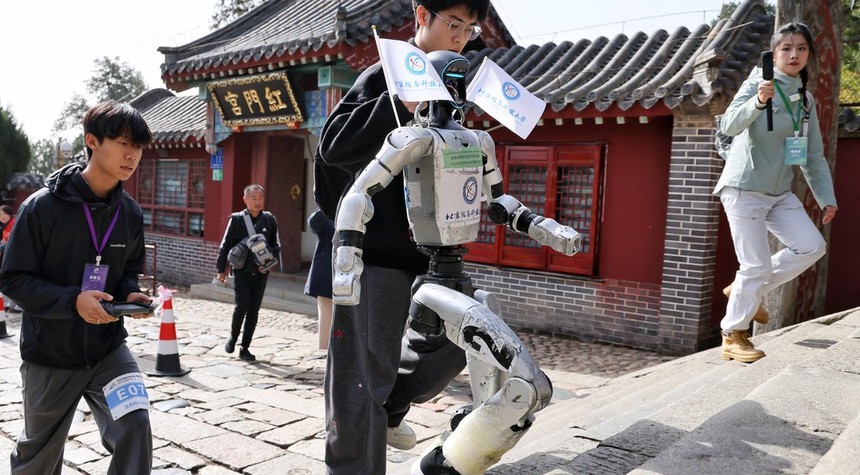
Dozens of advanced robots attempted to climb more than 3,000 steps up Mount Tai in eastern China’s Shandong province this week, marking what organizers described as a significant test of machine endurance under real-world conditions.
The UNESCO World Heritage site, which has served for centuries as a pilgrimage destination for Chinese emperors and holds deep significance in Chinese mythology, provided the demanding terrain for the inaugural World Mountain Robot Challenge. The choice of venue was deliberate. Organizers sought to move beyond controlled laboratory environments and subject these machines to the unpredictable conditions they would face in practical applications.
The competition required approximately 90 teams of robots and their engineers to navigate a 2.4-mile course featuring more than 1,970 feet of vertical ascent. Some competitors raced for speed alone, while others bore the additional burden of transporting fragile cargo, including fresh eggs and watermelons, to the summit without damage.
The results proved instructive about the current state of robotics technology. A four-legged robot manufactured by Beijing Lingyi Technology, a subsidiary of industry leader Unitree, completed the full course in 43 minutes and 41 seconds to claim victory in its category. This represents a significant achievement considering most human tourists require at least two hours to traverse the same route.
The fastest humanoid robot, developed by Beijing-based team Zhishen Lingyue, completed a shortened version of the course in 27 minutes and 26 seconds. However, the competition also revealed the limitations of current technology. One humanoid robot wearing a bandana suffered a mechanical failure and collapsed on the cobbled path, requiring immediate intervention from its engineering team. Another tumbled down a flight of stairs, coming to rest beside a rubbish bin, a stark reminder of the gap between controlled demonstrations and unpredictable real-world conditions.
The event, organized by the state-run China Media Group, offered cash prizes across several categories, including speed competitions and load-carrying challenges. Local media reports indicate organizers view Mount Tai’s rocky, irregular terrain as a natural proving ground that can accelerate the development of robots capable of functioning in practical scenarios beyond factory floors and research facilities.
This competition arrives as China continues its substantial investments in robotics and artificial intelligence, sectors Beijing has identified as critical to its technological advancement and economic ambitions. The practical nature of this challenge, testing machines against ancient stone steps and natural obstacles rather than purpose-built courses, suggests a focus on developing technology with immediate real-world applications.
The successful completion times achieved by the leading robots indicate meaningful progress in machine mobility and navigation systems. Yet the failures witnessed during the competition serve as important reminders that significant engineering challenges remain before such machines can reliably operate in the complex, unpredictable environments humans navigate daily. That is the way it is.
Related: Iranian Ghost Fleet Tankers Breach American Naval Blockade in Persian Gulf