
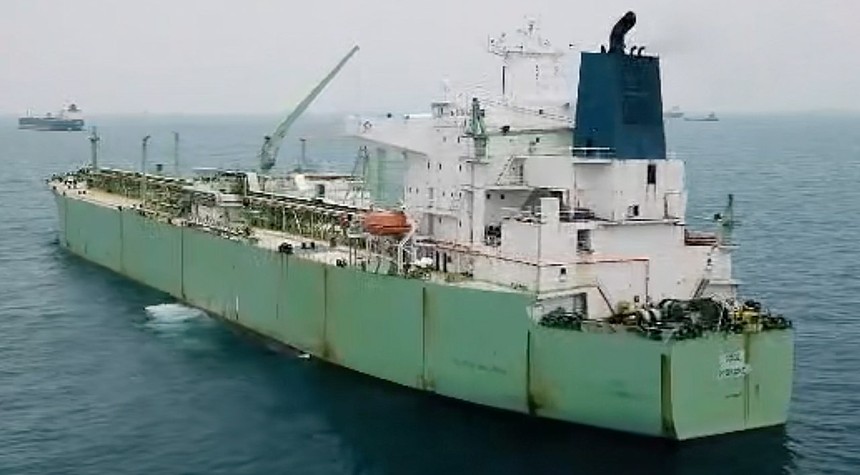
Iranian vessels are successfully penetrating the American naval blockade in the Persian Gulf, transporting sanctioned liquefied petroleum gas to Chinese ports through a sophisticated network of small tankers and offshore staging areas.
United Against Nuclear Iran has documented at least nine Iranian tankers carrying oil or liquefied petroleum gas that have evaded United States restrictions in the Strait of Hormuz since Washington reinstated its maritime blockade of Iranian ports this past July. The organization conducted a months-long investigation that included covert filming of one such vessel during its September voyage.
The investigation identified a sanctioned tanker designated as the SOGL, which investigators say breached the blockade on September 1st while carrying approximately 500,000 barrels of Iranian liquefied petroleum gas. The vessel had loaded its cargo at an Iranian port in August before embarking on a journey spanning thousands of miles.
The SOGL’s route took it to the Malaysian Eastern Outer Port Limits Anchorage, an offshore shipping area located approximately 70 kilometers from Malaysia’s coastline. This anchorage has emerged as a critical component in Iran’s efforts to maintain its sanctioned energy trade with China. At this location, vessels can wait offshore, receive supplies, and transfer cargo between tankers, effectively creating a logistical lifeline for Iranian energy exports while American naval forces maintain their patrol operations in waters closer to Iran.
Jemima Shelley, a senior analyst at United Against Nuclear Iran, explained that her organization had been monitoring the SOGL before its arrival in Malaysian waters. On September 16th, the organization chartered a supply vessel and traveled 100 nautical miles into the Malaysian Eastern Outer Port Limits Anchorage, where investigators witnessed what they describe as illicit activities involving ghost fleet tankers and Iran-flagged cargo ships.
“This tanker had loaded its Iranian liquefied petroleum gas from Assaluyeh Port, Iran, in late August. It then breached the United States blockade and made its way to a Malaysian anchorage,” Shelley stated. Following its stop at the Malaysian anchorage, the vessel continued to China, where it discharged its Iranian cargo.
The footage represents tangible evidence that some vessels are successfully navigating past American maritime restrictions. While Shelley emphasized that most vessels are not succeeding in their attempts, the fact that nine small tankers have managed to breach the blockade since its mid-July reinstatement represents a significant challenge to American enforcement efforts.
United States Marines aboard the USS New Orleans have been conducting watch operations in the Arabian Sea as part of the naval blockade operations against Iran. The persistence of these small-scale breaches, however, demonstrates the adaptive nature of Iran’s maritime smuggling operations.
The use of small tankers, often referred to as ghost fleet vessels due to their efforts to avoid detection, represents a calculated strategy by Iranian operators. These smaller vessels present more difficult targets for detection and interdiction compared to larger tankers that have traditionally carried Iranian energy exports.
The Malaysian anchorage’s role in this network underscores the international dimensions of sanctions evasion. By utilizing offshore areas beyond immediate coastal jurisdiction, these operations exploit gaps in enforcement geography while providing essential services to sanctioned vessels far from Iranian territorial waters.
This development arrives as the United States continues to target what it describes as Iran’s shadow fleet of tankers designed to circumvent international sanctions on Iranian oil and gas exports.
Related: Commonwealth Summit Offers Australian Leader Respite from Inflation Troubles