
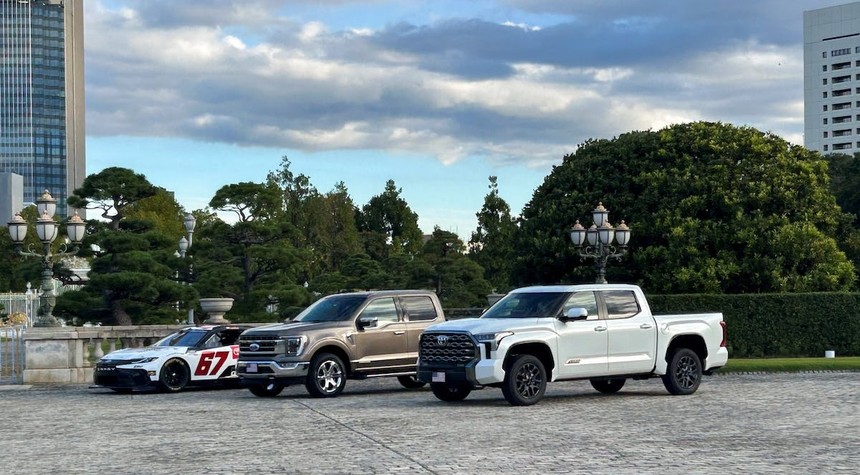
TOKYO — The placement of a single Ford F-150 pickup truck outside the Akasaka Palace during President Donald Trump’s meeting with Japanese Prime Minister Sanae Takaichi this week speaks volumes about the delicate choreography of international trade diplomacy.
The vehicle, an uncommon sight on Tokyo’s narrow streets, represented more than American automotive engineering. It stood as a tangible symbol of Japan’s effort to address longstanding trade concerns that have troubled relations between these Pacific allies for decades.
Prime Minister Takaichi, Japan’s first female premier, met with President Trump on Tuesday amid reports that her government has been assembling a comprehensive package of American purchases. The proposed acquisitions include F-150 trucks, soybeans, and natural gas. The F-150, which is not regularly available for sale in Japan, would likely be repurposed as snow removal equipment, according to Japanese government sources familiar with the discussions.
When asked about the reported purchases aboard Air Force One, President Trump offered his assessment. “Well, that’s great. She has good taste,” he said. “That’s a hot truck.” The president had previously mentioned Japan’s willingness to purchase the F-150 in August, describing it as “very beautiful.”
The exact number of vehicles under consideration remains unclear, but the gesture addresses a complaint President Trump has raised consistently throughout his political career. He has argued that Japan and European nations maintain barriers against American automobiles while their manufacturers sell millions of vehicles annually in the United States.
This is not the first time American vehicles have been deployed as diplomatic tools in United States-Japan trade relations. Three decades ago, Toyota responded to American pressure by selling a General Motors mid-sized car under its own brand in Japan. The Toyota Cavalier arrived with considerable fanfare but sold poorly and was quietly discontinued after several years, according to John Shook, a former Toyota manager and automotive industry veteran with experience in both nations.
The challenges facing American automakers in Japan extend beyond diplomatic gestures. Japanese consumers purchased 3.7 million new cars last year, with one-third of those being mini or “kei” cars. These tiny vehicles, designed specifically for Japan’s urban environment and tax structure, are not manufactured by American companies. Foreign cars overall accounted for just six percent of new car sales, with European brands claiming the majority of that modest share. Ford itself withdrew from the Japanese market nearly a decade ago.
During the Tokyo visit, President Trump announced that Toyota would invest ten billion dollars to open new automotive plants in the United States. A Toyota spokesperson was not immediately available to confirm these remarks.
The F-150 episode illustrates how modern trade negotiations often require symbolic gestures alongside substantive policy changes. Whether these gestures translate into meaningful shifts in trade patterns remains to be seen. What is certain is that both nations understand the importance of maintaining their alliance while addressing economic concerns that have persisted across multiple administrations.
And that is the way it is in the complex world of international trade, where a pickup truck can carry more diplomatic weight than its payload capacity might suggest.
Related: Sudan’s Military Loses Critical Base as Civil War Intensifies