
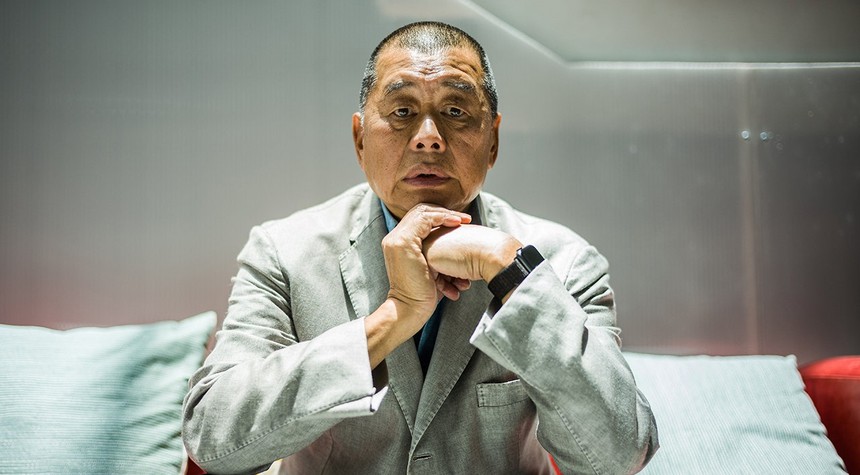
President Trump’s visit to China this week carries special significance for Claire Lai, whose father languishes in a Hong Kong prison cell under what many international observers consider to be a politically motivated sentence designed to silence dissent.
Jimmy Lai, a 78-year-old billionaire businessman, media mogul, and devout Catholic, was sentenced in February to 20 years imprisonment by a Beijing-backed Hong Kong court. His conviction on charges of sedition and conspiracy to commit collusion with foreign forces represents the longest sentence handed down under China’s national security law, a statute that legal experts believe was crafted specifically to silence the Communist regime’s most vocal critics.
More than 100 United States lawmakers have sent correspondence to President Trump urging him to raise Lai’s case directly with Chinese President Xi Jinping during their upcoming meeting. Claire Lai, however, has chosen to address Xi with her own message.
“If my father dies behind bars, he will die a martyr,” she stated. “And that is not something that China wants.”
The possibility of her father dying in prison is a reality with which Claire has been forced to reckon. The elderly Lai suffers from diabetes and numerous other medical conditions while being held in solitary confinement. The United Kingdom, where Lai holds citizenship, has characterized the sentence as effectively a death sentence given his age and deteriorating health.
Claire was unable to attend her father’s sentencing in person, marking the first time she had been absent from Hong Kong during such proceedings. “I was heartbroken,” she acknowledged. “It was a hard pill to swallow.”
Yet she drew strength from a letter her father sent following the verdict, in which he expressed his faith remained unshaken. He wrote that he was in the Lord’s hands and that the court’s decision could not alter that fundamental truth.
The sentencing has generated substantial international condemnation from governments and organizations concerned with religious freedom and freedom of expression. Secretary of State Marco Rubio characterized the verdict as “an unjust and tragic conclusion to this case.”
The British government, asserting its responsibility to protect its citizen, issued a strong condemnation of the sentence. Canada’s foreign affairs minister similarly denounced what he termed a “politically motivated prosecution” and demanded Lai’s release on humanitarian grounds.
Jimmy Lai built his fortune through his entrepreneurial ventures but became best known for his outspoken criticism of the Chinese government and his advocacy for democratic principles in Hong Kong. His media enterprises published content that Beijing’s leadership found objectionable, making him a target as the Communist Party tightened its grip on the formerly semi-autonomous territory.
The case has become emblematic of China’s broader crackdown on dissent in Hong Kong following the implementation of the national security law. What was once a vibrant hub of free expression in Asia has seen its civil liberties systematically dismantled as Beijing asserts greater control.
As President Trump prepares for his discussions with Chinese leadership, the fate of Jimmy Lai represents more than one family’s tragedy. It stands as a test of whether the United States will prioritize human rights and religious freedom in its diplomatic engagement with the world’s most populous authoritarian state.
For Claire Lai, the coming days may determine whether her father’s sacrifice will be acknowledged on the international stage, or whether expedience will once again take precedence over principle in dealings with Beijing.
Related: White House Signals Military Action May Resume as Iran Negotiations Falter