
An Iranian commercial vessel came under attack in the Strait of Hormuz early Sunday morning, resulting in one fatality and four wounded crew members, according to Iranian state media. The incident adds another volatile element to an already complex regional crisis that shows no signs of immediate resolution.
The Islamic Republic News Agency reported that an Iranian container ship was struck by an unidentified projectile near Hengam Island, as confirmed by the governor of Qeshm Island. The timing of this attack is particularly significant, occurring just hours before Iran was scheduled to meet with Gulf state representatives in Oman on Monday to discuss safe passage for shipping traffic through the strategically vital waterway.
This latest episode represents yet another flashpoint in what has become an increasingly dangerous situation in the Strait of Hormuz, the narrow passage through which approximately one-fifth of the world’s oil supply flows. The strait has emerged as the primary theater for ongoing military exchanges between the United States and Iran, even as both nations continue diplomatic negotiations that began in June.
The diplomatic effort followed President Donald Trump’s announcement on February 28th of major combat operations against Iran, which included massive joint American and Israeli strikes targeting military, government, and infrastructure sites throughout the Islamic Republic. Despite the signing of a memorandum of understanding aimed at producing a war-ending agreement, both nations have continued to exchange fire.
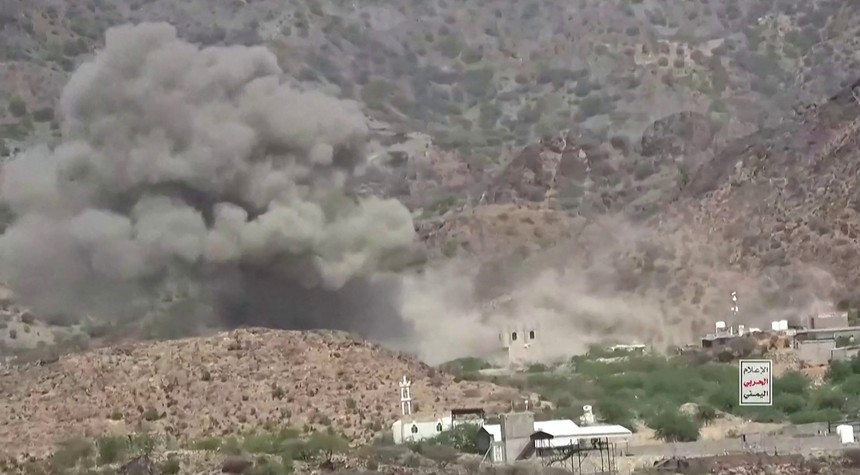
The regional instability extends beyond the Strait of Hormuz. Saudi Arabia reported Saturday that a projectile fired by Iran-backed Houthi rebels in Yemen struck the Al-Tawwal governorate in the Jazan region along the Red Sea coast. The attack injured two civilians and damaged a mosque, several buildings, and vehicles. As a precautionary measure, Saudi authorities have shut down the East-West pipeline.
Iraqi Prime Minister Ali al-Zaidi has ordered an investigation and dismissed the commander of Maysan province after authorities confirmed that attacks targeting a Saudi Arabian pipeline originated from within Iraqi territory along the Iranian border. The revelation underscores how Iran’s influence extends through proxy forces across multiple countries in the region.
President Trump confirmed he spoke with Saudi Crown Prince Mohammad bin Salman during a brief diplomatic encounter in Dublin on Saturday. When questioned about the substance of their conversation and potential American response to recent attacks, the President remained characteristically circumspect. “I have had a call with MBS. He’s a good friend of mine,” Trump stated, adding only that the situation would “work out fine and dandy.”
The President’s August warning of a “crushing economic operation” to force Tehran into submission appears to remain on the table as one option among many being considered by American policymakers. However, the continuation of strikes even during active negotiations raises serious questions about whether diplomatic solutions can be achieved while military operations proceed simultaneously.
As Monday’s talks in Oman approach, all parties face the difficult reality that freedom of navigation through the Strait of Hormuz remains under threat, with global economic implications that extend far beyond the immediate region.
Related: Beijing Faces Questions Over Satellite Data Used in Fatal Attack on American Forces