
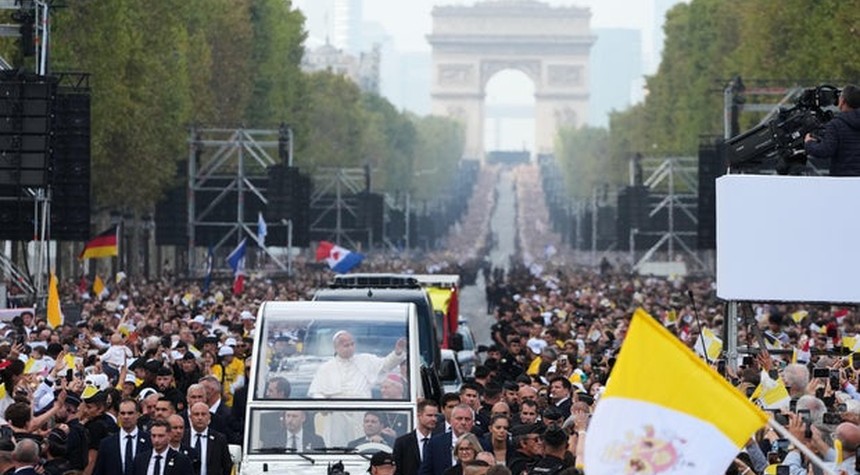
Eight hundred thousand people filled the Champs-Élysées in Paris on Saturday for an outdoor Mass celebrated by Pope Leo XIV, a remarkable demonstration of Catholic vitality in a nation long defined by its rigid secularism. The turnout exceeded advance registrations by two hundred thousand, suggesting a groundswell of interest that surprised even Church officials.
The numbers tell a story that defies conventional wisdom about religious decline in Western Europe. France, birthplace of Enlightenment rationalism and enforcer of strict separation between church and state, witnessed scenes more commonly associated with World Cup victories than papal visits. Central Paris came to a standstill, not from protest or celebration of secular achievement, but from citizens seeking spiritual connection.
Pope Leo XIV used the occasion to challenge French Catholics directly, urging them “to build a renewed nation upon roots nourished by faith.” This was not merely ceremonial language. The pontiff has made clear throughout his four-day visit that he views France as a testing ground for Catholic revival in hostile cultural territory. His message acknowledges the reality of what he calls living “even amid the thorns” of secular society.
The statistics present a complex picture. Adult baptisms in France have tripled since 2016, reaching thirteen thousand this year. More than twenty-one thousand adults and teenagers were baptized at Easter alone, a significant increase from the previous year. Yet overall baptisms have plummeted from five hundred thirteen thousand in 1980 to one hundred eighty-six thousand in 2024. The Church is gaining converts while losing generational Catholics, a demographic shift with profound implications.
The revival appears genuine rather than manufactured. Leontine Joseph, a forty-two-year-old Catholic, attended with two friends of Moroccan Muslim background, noting that “the message of Pope Leo goes well beyond Catholic people; he speaks about social justice, for example.” The interfaith appeal suggests the Pope’s message resonates beyond traditional Catholic boundaries.
Jean-Claude Farnabe, who celebrated his sixty-third birthday by securing a spot among the crowds, attends Mass weekly in the Paris suburb of Suresnes. He reports witnessing increasing conversions firsthand. “There are more and more converts,” he observed while waiting for the papal procession.
The visit included prayer at the restored Notre Dame Cathedral, the first papal visit since the devastating 2019 fire, and will conclude with a pilgrimage to Lourdes. The Notre Dame stop carried symbolic weight, representing both physical reconstruction and spiritual renewal.
The party-like atmosphere drew people across faith traditions and generations. Parents brought infants and young children for the Pope to bless from the popemobile, scenes reminiscent of an earlier era when Catholic ritual pervaded French public life.
France’s experience mirrors trends in secular Spain, where similar baptism increases have been recorded. Whether this represents temporary curiosity or lasting revival remains uncertain. What seems clear is that reports of European Christianity’s death have been premature. In an age of isolation and digital disconnection, eight hundred thousand people chose to gather in person for an ancient ritual. That fact alone merits attention, regardless of what trends emerge in coming years.
The question facing Church leaders and cultural observers alike is whether these converts will sustain faith through coming decades, or whether France’s secular tide will ultimately prove stronger than this moment of religious enthusiasm suggests.
Related: Estonia Sees No Evidence Russia Preparing Full-Scale NATO Invasion