
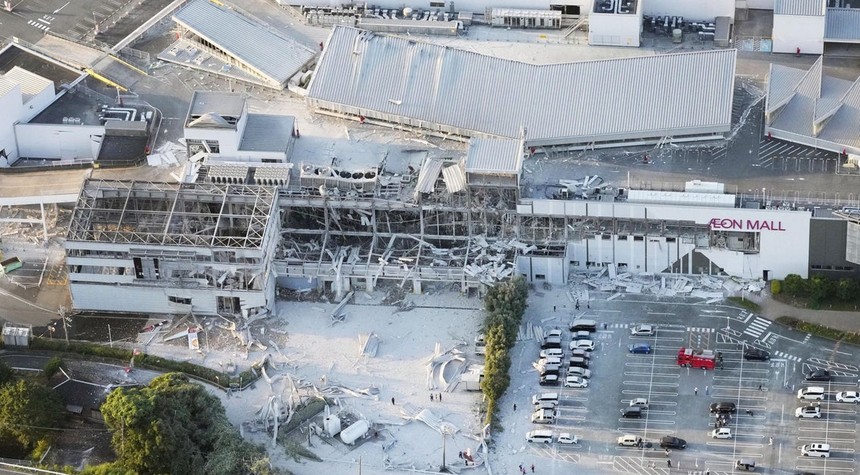
A powerful earthquake struck southwestern Japan on Tuesday afternoon, collapsing buildings and igniting fires across the region as emergency services mounted rescue operations to reach dozens of people trapped beneath rubble.
Prime Minister Sanae Takaichi confirmed the disaster struck at 4:27 p.m. local time, registering a magnitude of 7.1 according to the Japan Meteorological Agency. The tremor reached the highest possible level of seven on Japan’s Shindo scale, which measures seismic intensity. The United States Geological Survey recorded the earthquake at magnitude 6.8.
The most severe damage occurred in Kashima, where the second floor of a shopping complex collapsed, leaving numerous individuals trapped inside. Local police sources indicated there were “a lot of deaths” at the damaged Aeon Mall, though authorities stated it would take considerable time to confirm exact casualty figures. At least fifty people were transported to area hospitals as rescue operations continued into the evening.
“We are still assessing the extent of injuries and property damage, but I have been informed that there have already been several injuries,” Takaichi stated. “Power outages and fires are happening in some areas, and roads and bridges have been damaged and buildings collapsed.”
Video footage broadcast throughout Japan showed multiple fires burning across the affected region, damaged bridges, a derailed cargo train, and roads split by deep fissures. At least twelve houses collapsed entirely, while one confirmed fatality occurred when a residence crumbled during the initial tremor.
Additional individuals remained unaccounted for at a Japan Paper Industries factory, where the top portion of a chimney collapsed during the earthquake. Emergency services continued search operations at multiple sites as aftershocks complicated rescue efforts.
The earthquake struck at the southern end of Kyushu, Japan’s main southern island. The Japan Meteorological Agency initially issued a tsunami warning for waves up to three feet, but withdrew the alert after two hours when the threat did not materialize.
Approximately 45,000 households and facilities lost electrical power in the Kumamoto region, according to Kyushu Electric Power. The utility company confirmed that three nuclear reactors operating in the area at the time of the earthquake continued functioning normally. The Nuclear Regulation Authority reported no immediate abnormalities at any nuclear power facilities.
A local news staffer, wearing protective headgear during a live broadcast, reported that tremors continued more than thirty minutes after the initial earthquake. The individual described shaking so violent that standing proved difficult.
“When the quake struck, the shaking was so big that I could not stand up,” the reporter stated, warning viewers to prepare for continued seismic activity.
Japan experiences hundreds of earthquakes annually, though the vast majority cause minimal damage. The Kumamoto region previously suffered two devastating earthquakes in 2016, which killed dozens and caused widespread destruction.
This latest disaster underscores the persistent seismic vulnerability facing the island nation, despite decades of implementing stringent building codes and emergency preparedness measures. As rescue operations continue, the full scope of casualties and structural damage remains under assessment.
Related: Turkish Telecommunications Ties to China Complicate F-35 Aircraft Deal