
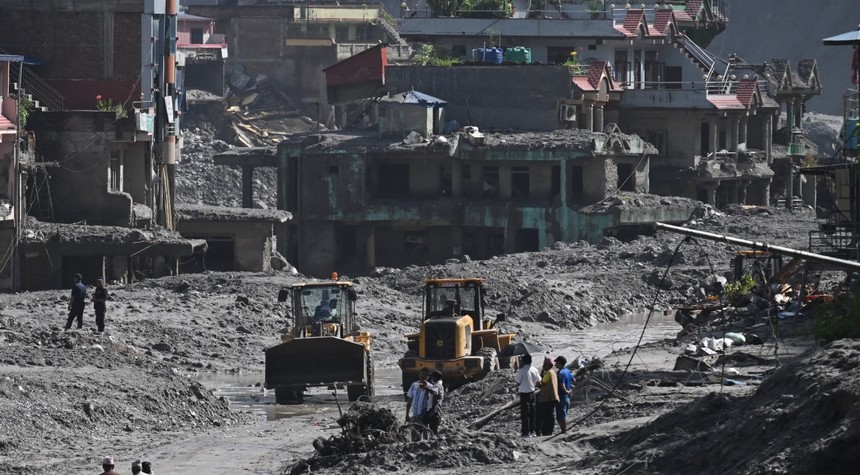
The full scope of devastation from a catastrophic glacier collapse in the Himalayas continues to emerge five days after floodwaters swept through communities in Nepal and China’s Tibet region, burying entire areas under thick mud and claiming hundreds of lives.
Nepalese authorities reported Sunday that the death toll has climbed to 752, with more than 2,500 people remaining unaccounted for. Among the missing are 592 foreign nationals, including approximately 100 American citizens, according to the State Department. The Nepal Tourism Board has confirmed that 261 foreign nationals have been rescued from the disaster zone.
China has separately reported 16 deaths and 546 missing persons in its Tibet region, though it remains unclear how much overlap exists between the Chinese and Nepali missing-person counts, given that 261 foreign nationals are included in China’s figures as well.
Rescue operations face considerable obstacles as teams work to reach isolated communities. The danger extends beyond the immediate flooding. A landslide has created a dammed lake above the border checkpoint that continues to overflow, while fresh rainfall across Nepal has raised river levels once more, prompting renewed warnings for residents in low-lying areas.
Nepal’s Flood Alert system issued advisories Sunday indicating that heavy rainfall had been measured in watershed areas of Gandaki Province, with water levels expected to rise further. Authorities have urged residents in riverside communities to exercise extreme caution.
The physical conditions confronting rescue workers are formidable. Operations teams describe working through deep mud as both exhausting and hazardous, with the combination of organic matter and standing water creating serious health risks. The longer bodies remain in such conditions, the greater the danger of disease transmission becomes.
The grim task of identifying victims has overwhelmed local facilities. In Nepal’s Chitwan district, where numerous bodies have been recovered downstream, authorities report that more than half of the deceased are beyond visual recognition. Many bodies are incomplete, with only partial remains recovered. Morgues across the affected region have reached capacity, though officials are collecting DNA samples in hopes of eventually notifying family members.
For those awaiting word about missing loved ones, the wait may be prolonged and difficult. The force of the floodwaters carried debris and victims considerable distances downstream, complicating both search efforts and identification processes.
The disaster began when a glacier collapsed, sending massive volumes of water cascading down the mountainside. The sudden deluge swept away entire communities with little warning, transforming the landscape within moments.
Residents in affected areas describe the psychological toll of repeated flood warnings since the initial catastrophe. Families with elderly members face particular hardship, forced to evacuate repeatedly to higher ground at all hours, including during nighttime, while continuing rainfall adds to their distress.
The international community continues to monitor the situation as rescue operations proceed under challenging circumstances. The coming days will be critical as authorities work to stabilize the region and account for those still missing.
Related: Proposed US Deal for Venezuelan Energy Fields Draws Sharp Opposition