
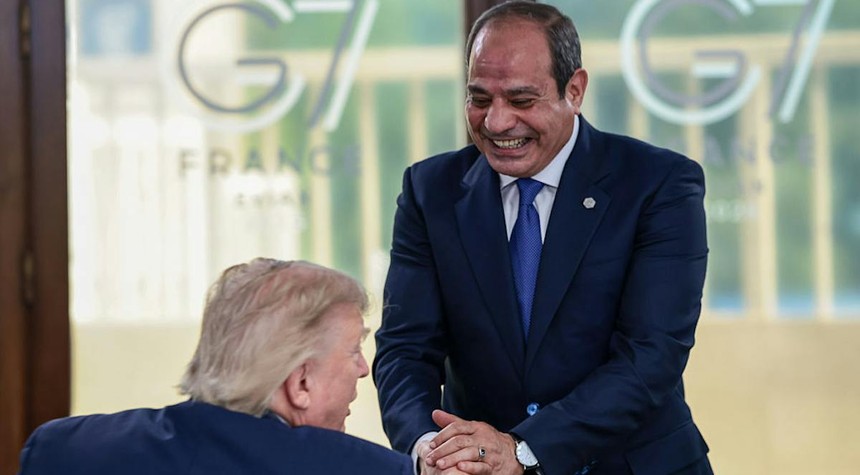
Secretary of State Marco Rubio authorized the release of $320 million in military assistance to Egypt this week, waiving human rights conditions that typically govern such transfers. The decision, framed as essential to American national security interests, comes as Cairo maintains its role as mediator in the ongoing regional conflict involving Iran.
The funds represent a portion of the $1.3 billion in annual military financing that Washington provides to Egypt. The State Department justified the waiver by citing President Abdel Fattah el-Sisi’s government as a crucial diplomatic intermediary in Middle Eastern affairs. The money will allow Cairo to procure American-manufactured military equipment without the restrictions Congress typically imposes based on human rights considerations.
And that is the way it appears on paper. But beneath the surface of this transaction lie concerns that merit careful examination by anyone watching American foreign policy in the Mediterranean and beyond.
The timing of this aid package raises substantive questions. Between late August and early September, Egyptian and Chinese air forces conducted joint exercises on African soil. These drills marked the first deployment of China’s advanced J-16 fighter aircraft to the continent. For Washington to approve hundreds of millions in military assistance shortly after Cairo conducted war games with America’s primary strategic competitor represents a diplomatic calculation that deserves scrutiny.
The historical record provides additional cause for concern. Egyptian authorities have long maintained border security along the Philadelphi Corridor, yet for years that border proved porous to Hamas smuggling operations. Sophisticated weaponry flowed through tunnel networks into Gaza, weapons that were later deployed in the October 7, 2023 attacks that claimed Israeli lives. Whether through negligence or design, Cairo’s management of that border failed to prevent a massacre.
The Sinai Peninsula itself remains a volatile region. Following the upheaval of the Arab Spring in 2011, extremist organizations gained footholds there. Ansar Bait al-Maqdis, which later declared allegiance to the Islamic State as Wilayat Sinai, carried out devastating attacks including the bombing of a Russian commercial airliner in 2015 that killed 224 people and an assault on a Sinai mosque in 2017 that left over 300 worshippers dead.
Military analysts have observed that Egypt’s armed forces expansion appears disproportionate to defensive requirements. Despite an economy strained by inflation, fuel price increases approaching thirty percent, and the loss of approximately $10 billion in Suez Canal revenues, Cairo continues acquiring advanced military capabilities including modern fighter aircraft, main battle tanks, unmanned combat aerial vehicles, and naval vessels suitable for Mediterranean operations.
Former Israeli Defense Forces intelligence officer Lieutenant Colonel Eli Dekel has documented what he describes as violations of existing peace agreements. His reports indicate Egyptian forces have positioned armor near the Israeli border and constructed approximately sixty hardened underground facilities within Sinai, structures capable of concealing offensive military systems from aerial reconnaissance.
Egyptian state media has broadcast content depicting simulated strikes against Israeli armored forces, while military spokesmen have made public statements about combat readiness and preparation for potential confrontation.
The question before American policymakers is straightforward: Does providing substantial military assistance to a government conducting exercises with Beijing, maintaining ambiguous border security, and building offensive capabilities near a key American ally serve the interests of the United States?
The answer to that question will reveal much about the direction of American foreign policy in a region where the cost of miscalculation has historically been measured in lives.
Related: Security Researcher Exposes Dangerous Vulnerabilities in Chinese AI System